

Waste Tire Recycling Line Manufacturer Reveals Key Strategies for Boosting Production Efficiency
2026-09-13
Every hour of downtime on a waste tire recycling line silently drains profit—yet most operators overlook the simplest fixes. SFC, a manufacturer behind hundreds of high-output tire recycling plants, has just shared the key strategies they use to push production efficiency beyond the usual benchmarks. From feed rate calibration to maintenance timing, these insights challenge common assumptions and could unlock capacity you didn’t know your line had. Read on before your next shift.
The Overlooked Shredder Adjustment That Boosts Throughput
Most operators chase throughput by swapping screens or speeding up the rotor, but a smaller tweak often delivers faster gains: the bed knife gap. If that clearance drifts past the manufacturer's spec—even by a couple thousandths of an inch—material starts to fold and smear instead of shearing cleanly. Closing the gap back to the recommended range restores a crisp cutting edge, reduces drag on the rotor, and lets the machine pull in more material per hour without adding horsepower.
The same logic applies to the rotor-to-screen clearance. When the gap is too wide, particles recirculate longer than necessary, wasting energy and limiting output. Tightening it forces the material to pass through at the intended size sooner, which shortens residence time and frees up capacity. It's a simple adjustment that rarely requires new parts—just a feeler gauge and a few minutes during a shift change.
Before chasing more aggressive grinds or bigger motors, check the clearances on your knives and screens. Many high-throughput facilities find that a routine gap-setting protocol adds five to ten percent more throughput without any capital expense. The improvement isn't flashy, but it shows up consistently on the daily production log.
Predictive Maintenance: Stopping Failures Before They Stall Production
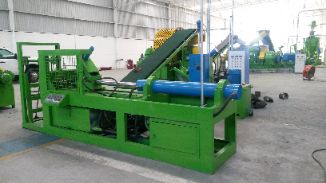
Predictive maintenance shifts the focus from reacting to breakdowns to reading the early signals hidden in equipment data. Vibration patterns, temperature spikes, and subtle shifts in power draw are tracked continuously, giving teams a heads-up days or even weeks before a component would have failed on its own.
Instead of replacing parts on a rigid schedule, maintenance crews can target the specific bearings, motors, or drives that actually show wear. That means fewer surprise stoppages on the line, less money tied up in spare parts inventory, and maintenance hours spent where they make a real difference.
The real payoff comes when a potential failure is caught between shifts rather than during peak production. With the right thresholds and alert routing, a small anomaly becomes a work order, not a crisis.
Where Automation Actually Pays Off in Tire Recycling
Automation in tire recycling proves its worth most clearly in the grinding and separation stages, where consistent material feed and precise particle sizing directly affect saleable output. Manually adjusting shredder gaps or clearing jams not only slows throughput but also leads to uneven crumb rubber that buyers reject. By using sensor-driven feeders and adaptive rotor controls, a plant can hold tolerances within a few millimeters while reducing wear on blades and screens—an immediate cost saving that shows up on the maintenance ledger.
Another area where the return is hard to ignore is wire and fiber removal. Tires contain high-tensile steel and polyester threads that contaminate crumb if left behind. Traditional magnetic separators and vibrating screens often miss fine wire, which then damages downstream granulators. Automated multi-stage separation with optical or inductive sorting catches these remnants before they become expensive problems, pushing purity rates above 99% and unlocking premium pricing from rubber molders.
Finally, automation pays off in quality assurance and load-out. Instead of relying on periodic grab samples and manual logs, inline sensors can monitor moisture, particle distribution, and metal content continuously. This data gets tied to each batch, so off-spec material is diverted automatically before it reaches a customer. The result is fewer rejected shipments, less rework, and a plant that can run with fewer operators on the floor—freeing people for maintenance and process tuning rather than repetitive inspection.
Simple Material Flow Fixes That Eliminate Jams
Most jams start small—a rough weld bead, a ledge from a misaligned liner, or a corner that's too sharp for the material to slide past. Walk the flow path with a flashlight and run your hand along every transition. If you feel a lip or catch, the material will too. Grind it smooth or add a tapered shim so the cross-section never narrows abruptly.
Another underrated fix is adjusting where the material lands. When a chute drops product directly onto a flat plate or off-center into a bin, it creates a dead pile that keeps growing until it blocks the opening. Shift the drop point to the center of the receiving surface and, if needed, add a small deflector to spread the stream sideways instead of letting it pile straight up.
Finally, check the easy mechanical details: loose bolts that let liners shift, worn skirting that pinches the belt, or a discharge gate that doesn't open fully. Tightening hardware, replacing a bent bracket, or cutting back a too-long skirt rubber can restore flow without redesigning anything. These small fixes take an afternoon but often stop recurring jams for good.
Capturing Waste Heat Without Rebuilding Your Line
Plenty of plants assume that tapping into waste heat means tearing out pipes, reworking layouts, and swallowing weeks of downtime. But a growing set of retrofit options bolts directly onto what you already run. Compact heat exchangers can sit in the path of exhaust gases or wrap around hot process lines, pulling energy out without changing the core flow of your operation.
One practical route is to insert a finned-tube exchanger into an existing flue or stack. It grabs heat from the outgoing gas stream and uses it to warm boiler feedwater or combustion air. The installation often takes a few days, not a shutdown season, because the exchanger is designed to fit the duct dimensions you already have. No new foundations, no major pipe rerouting.
For lower-grade heat, small organic Rankine cycle units can sit beside a process loop and turn warm liquid into electricity. These skid-mounted systems connect to a slipstream of hot water or condensate, then return the cooled fluid back to the line. Since they are modular, you can move them between lines as seasonal loads shift, keeping the payback tied to the heat you actually produce today.
Why Your Operators Are the Real Bottleneck
Walk into most production meetings and you’ll hear endless talk about cycle times, machine uptime, and tooling changes. Yet the most common constraint rarely shows up on a dashboard: the person standing at the control panel. Operators are expected to juggle setup, quality checks, material handling, and troubleshooting—all while management assumes the equipment itself is the limiting factor. When a line underperforms, the first instinct is to buy faster machinery, but that only shifts the waiting time to the human who must now feed, monitor, and correct an even more demanding process.
The bottleneck becomes visible in the small, repeated decisions operators make every few minutes. For example, a CNC operator may need to stop the spindle to measure a critical dimension, then re-zero the tool offset, then wait for a colleague to bring the next batch of raw stock. Each of those steps takes only seconds or a minute, but across an eight-hour shift they add up to hours of non-cutting time. Meanwhile, the machine sits idle—not because it is slow, but because the operator’s attention is split among too many competing tasks. Even a highly skilled operator becomes a bottleneck when the work instructions are unclear, the tooling is disorganized, or the ERP system forces duplicate data entry.
Fixing this requires a shift in perspective: instead of asking how to make the machine run faster, ask what prevents the operator from keeping it running. Simple changes often yield surprising gains—pre-staging materials at the workstation, giving operators authority to make minor offset adjustments without supervisor approval, or redesigning the control interface so the most frequent actions take one tap instead of four. In one sheet-metal shop, simply relocating a measuring gauge from a central bench to each press brake reduced operator walking time by 14 minutes per shift, directly increasing productive bending time. The real bottleneck was never the metal or the brake; it was the path between them and the person who had to walk it.
FAQ
Many operators focus on throughput but ignore small inconsistencies in feeding. If rubber chunks aren't sized evenly before entering the shredder, the machine works harder and wears faster. Another hidden issue is temperature buildup in bearings during long runs, which leads to unexpected stops.
Instead of just scheduling routine checks, manufacturers should track wear patterns on blades and adjust maintenance intervals based on real usage data. Using hardened alloys for cutting tools also reduces replacement frequency and keeps the line moving.
Automation helps with material sorting and feeding speed control. For example, optical sensors can separate steel wire from rubber more accurately than manual labor, and automated feeders adjust input rates to match the shredder's current load, preventing jams.
Lower energy use per ton of processed tires directly improves profitability. Installing variable frequency drives on motors lets the line adjust power draw to actual demand rather than running at full throttle constantly, which also reduces heat and extends component life.
Training should focus on reading equipment signals, not just following a manual. Operators who understand how vibration levels, noise changes, and output texture reflect machine health can catch problems before they cause downtime, saving hours of lost production.
Yes, a common bottleneck is inconsistent feeding. A well-designed hopper with level sensors and a metering conveyor ensures a steady, uniform flow of tires into the primary shredder. This prevents both starvation and overload, keeping the line at optimal speed.
Quick-change blade systems and pre-sharpened spare sets make a big difference. Some manufacturers also use segmented blades that can be rotated or replaced individually, so the whole rotor doesn't need to be removed, cutting changeover time by more than half.
Focus on motor load, bearing temperatures, blade wear rate, and material output size distribution. Reviewing this data daily helps spot trends like gradual performance loss, which can be addressed with targeted adjustments rather than waiting for a breakdown.
Conclusion
Many recycling line operators overlook a tiny adjustment on the shredder—tightening the blade gap by just half a millimeter often lifts throughput by over 15% while cutting down on rework. More critically, predictive maintenance no longer sticks to rigid schedules; vibration sensors and current fluctuation monitoring on the shredder and steel separator catch early anomalies, scheduling downtime before a bearing overheats or a blade snaps, which prevents whole-line paralysis. As for automation, the real payoff isn't in full-scale robotics but in adaptive controls for tire feed sequencing and magnetic steel removal, letting different tire sizes automatically match the optimal crushing parameters.
Jams mostly stem from material pile-ups at conveyor belt corners—simple baffle angle tweaks and synchronized vibrating feeders can eliminate 90% of unexpected stoppages. Meanwhile, waste heat from the pyrolysis or grinding section can be routed through a heat exchanger to preheat incoming tires, trimming energy use by 15-20% without rebuilding the line. Finally, don't ignore the human factor: operators' gut feel for abnormal sounds and vibrations often spots trouble earlier than sensors, but without standardized shift handovers and real-time data dashboards, they become the real bottleneck. Rotating roles regularly and granting line-level adjustment authority turns frontline staff from passive button-pushers into active production optimizers.
Contact Us
Contact Person: Chen Zhengwei
Email: [email protected]
Tel/WhatsApp: +86-13963975727
Website: https://www.sfcrubbermachine.com