
Top FRP Structure Solutions for Durable and Lightweight Construction
2026-09-08
In modern construction, the push for materials that are both durable and lightweight has never been stronger. From industrial walkways to chemical processing plants, traditional steel and concrete often fall short—corrosion, heavy dead loads, and high maintenance costs are constant battles. FRP (Fiber-Reinforced Polymer) structures are changing that equation. But with so many options on the market, how do you identify the top solutions that truly deliver long-term performance without the extra weight? This guide cuts through the noise, spotlighting the proven FRP structural systems that engineers and contractors rely on. As a leading manufacturer in the field, Sino Grating has seen firsthand which designs hold up under real-world stress—and which ones don't. Read on to discover the FRP solutions that are redefining what lightweight construction can achieve.
FRP Composites Replacing Heavy Steel in Structural Framing
The shift toward fiber-reinforced polymer (FRP) composites in structural framing is driven by weight savings that steel simply cannot match. A carbon or glass FRP beam often weighs a quarter of an equivalent steel section while carrying comparable service loads. This changes lift planning, foundation sizing, and erection sequencing on congested sites, where crane capacity and access dictate schedule. Contractors are finding that lighter members cut transportation costs and allow faster assembly without sacrificing stiffness when layup orientations are tuned for specific bending and shear demands.
Corrosion resistance pushes FRP further into applications where steel would require constant maintenance or protective coatings. Marine environments, chemical processing plants, and water treatment facilities expose framing to chlorides and acids that rapidly degrade carbon steel. FRP pultrusions and molded sections eliminate the repaint cycle and reduce lifecycle inspection burden. While the upfront material cost per pound remains higher, owners looking at total cost over 30 years see a different picture—fewer shutdowns, no galvanizing or epoxy touch-ups, and longer replacement intervals.
Design codes have matured enough to make FRP a practical alternative rather than an experimental one. Standards now cover fire performance, bolted and bonded connections, and long-term creep behavior. Engineers can specify FRP beams and columns with documented allowables instead of relying on proprietary test data. Combined with hybrid systems—FRP tubes filled with concrete, for example—structural framing gains ductility and compressive capacity that pure polymer sections lacked a decade ago. This is not a one-for-one steel swap, but a different way of framing that rewards early integration with architecture and MEP coordination.
Pultruded Beams Built to Ignore Moisture and Chemicals
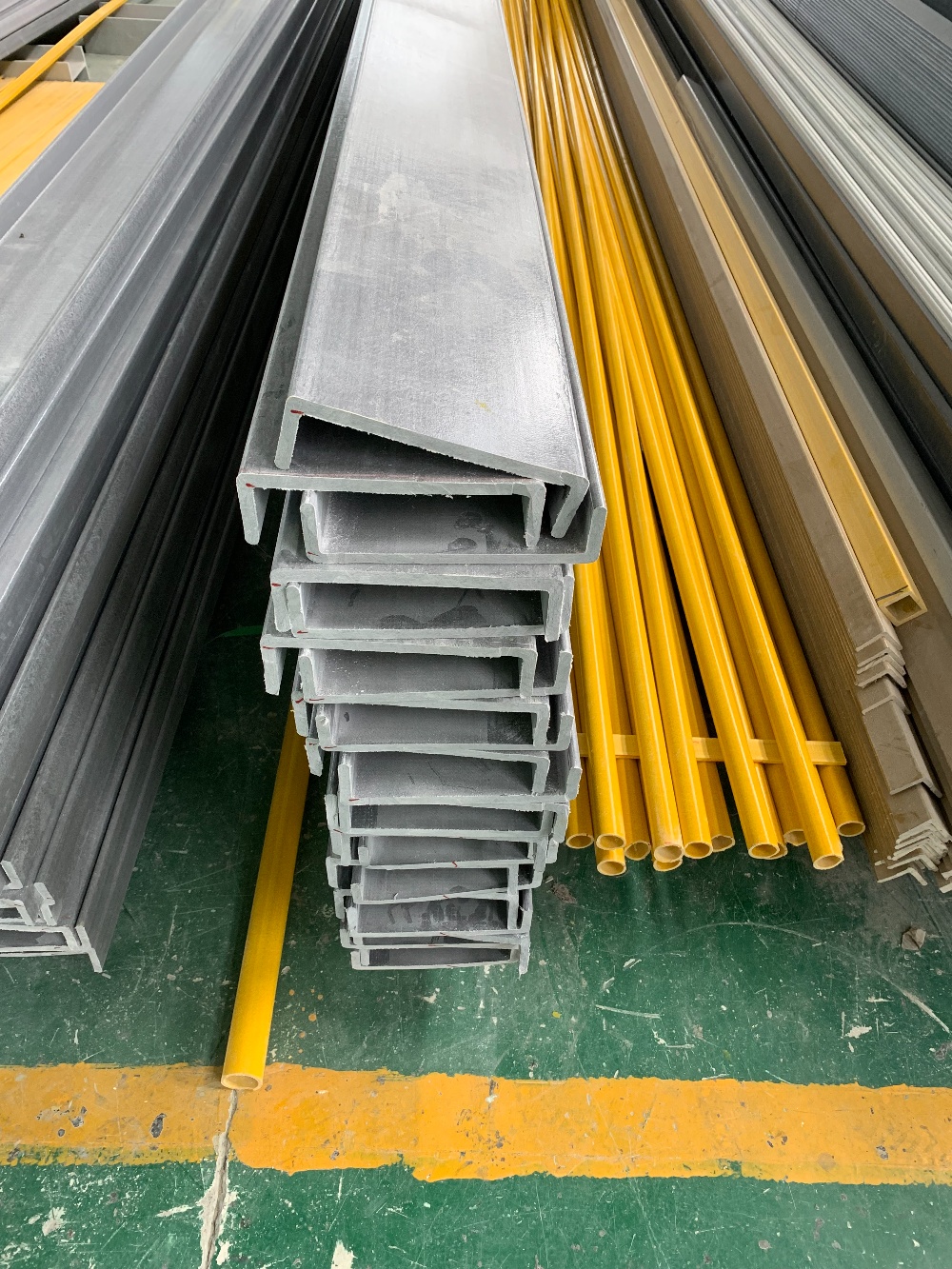
Pultruded beams start with continuous glass fibers pulled through a thermoset resin bath, then cured into a solid profile under heat and tension. The resulting matrix is dense and non-porous, so there are no capillary paths for water to wick into or micro-cracks for chemicals to exploit. Unlike coated steel or sealed wood, the moisture resistance isn't a surface treatment—it exists through the entire cross-section, which means scratches or field cuts don't create entry points for corrosion.
In environments that eat conventional materials—think chlorine rooms, acid rinse stations, or saltwater docks—these beams stay dimensionally stable. They don't swell, rot, or develop rust blooms. A pultruded beam doesn't care if it sits in standing water or gets splashed with caustic solutions every shift. That inertness comes from the resin system, which can be formulated for specific chemical exposures, so the beam behaves more like a ceramic than a structural timber.
The practical payoff shows up in maintenance schedules. No sandblasting, no repainting, no annual coating inspections. Since there's no galvanic reaction and no moisture absorption, connections stay snug and load ratings don't drift over time. For water treatment plants, chemical storage buildings, or coastal walkways, that translates to fewer shutdowns and a lower total cost of ownership—not because the beam is cheap, but because it simply refuses to degrade the way most building materials do.
Lighter Structures, Smaller Foundations, Lower Total Cost
Reducing the dead weight of a building changes everything downstream. When the superstructure sheds mass, the load path shrinks and the foundation no longer has to fight gravity with oversized footings or deep piles. This isn't a marginal tweak; it's a shift that ripples through the entire project budget.
Smaller foundations mean less excavation, less concrete, and fewer truck rolls to the site. On tight urban lots or weak soils, that advantage compounds fast. You're not just saving on material volumes—you're cutting labor hours, curing time, and the risk of hitting unexpected subsurface conditions. The savings show up before the frame even goes up.
When you lower the total structural weight, you also open the door to simpler connections and lighter equipment. Cranes, pumps, and formwork all scale down. The result is a project that costs less to build and often less to insure, because there's simply less mass in play. It's a compounding return that starts with a lighter decision at the top.
Snap-Together FRP Decks That Cut Installation Weeks
Traditional fiberglass deck installation drags on because every panel has to be measured, shimmed, and through-bolted on site. Snap-together FRP decking flips that rhythm. Panels arrive with interlocking edges and pre-set gaskets, so a three-person crew can walk a 40-foot span into place before lunch. Alignment tabs hold the joints flush while workers secure the underside, which removes most of the layout guesswork and nearly all of the drilling.
The time savings compound on multi-level platforms and catwalks. Instead of staging a crane for each lift or waiting on a specialty contractor, general laborers can carry the lightweight panels up a ladder and click them together in sequence. One chemical plant replaced a 600-foot walkway in eleven days; the previous bolted system had taken eight weeks. That kind of reduction changes outage planning, letting operations restart while competitors are still waiting on scaffolding.
Marine and Wastewater Applications Where FRP Wins
In coastal pumping stations and harbor structures, steel walkways and railings rarely survive more than a few years without aggressive maintenance. FRP grating and handrails, by contrast, shrug off salt spray, tidal immersion, and even occasional fuel or chemical spills. The material's natural dielectric properties also eliminate galvanic corrosion risks that plague mixed-metal assemblies near seawater.
Wastewater plants face a different but equally harsh cocktail: hydrogen sulfide, sulfuric acid formed by microbiological activity, and abrasive solids. FRP troughs, weirs, and odor-control ducting handle these without the pitting and wall loss common in coated carbon steel. Because FRP is roughly a quarter the weight of steel, retrofit projects can often use existing support structures, cutting installation time and crane costs.
Perhaps the clearest win comes from looking at whole-life cost rather than purchase price. A stainless steel clarifier component may cost less upfront, but replacement after seven years of chloride stress cracking wipes out that advantage. FRP fabricators can tailor the resin system—vinyl ester for bleach exposure, isophthalic polyester for general corrosion—so the part lasts twenty years or more with only occasional washing. That's why more utilities and port authorities now specify FRP as the default for anything that touches seawater or raw sewage.
After 30 Years: The Lifecycle Case for Fiberglass
Thirty years is a long time for any building material. Wood rots, steel corrodes, and concrete spalls, but fiberglass often looks nearly the same as the day it was installed. This isn’t luck—it’s the nature of the resin-and-glass matrix. When you look at a fiberglass panel that has spent three decades on a rooftop or a cooling tower, the surface may have lost some gloss, but the core strength remains. That longevity changes how we should think about its lifecycle.
The real case for fiberglass after 30 years is economic. A material that doesn't need replacement for three decades—or longer—dramatically lowers the total cost of ownership. Compare that to wood decking that needs staining every few years and replacement at 15-20 years, or steel that requires constant paint and patching. Fiberglass just sits there. Maintenance is minimal: an occasional wash, maybe a fresh topcoat if you want the shine back. That’s a lifecycle advantage you can measure in avoided labor, avoided downtime, and avoided disposal fees.
Then there's the end-of-life question. After 30 years, when a fiberglass component finally does come down, it doesn't have to go straight to a landfill. Processes exist to grind it into filler or use it as fuel in cement kilns, though recycling infrastructure is still uneven. But the bigger environmental win is what didn't happen for 30 years: no replacement manufacturing, no repeated transportation, no repeated installation waste. A material that endures quietly for three decades often beats a "greener" material that needs replacing three times in the same span.
FAQ
FRP combines high tensile strength with a fraction of steel's weight, so you get structural integrity without overloading foundations or complicating transport. It also resists corrosion, which keeps the material stable over decades even in wet or chemical-heavy settings.
They outperform both in many corrosive settings. Steel rusts and wood rots or attracts pests, but FRP doesn't absorb moisture or react with salts, acids, or industrial runoff. UV-stabilized grades also avoid the brittleness that plagues some plastics left in sunlight.
Marine, wastewater treatment, chemical processing, and pedestrian infrastructure see the biggest gains. Any site where moisture, salt spray, or chemical exposure is constant can cut replacement cycles by switching to FRP beams, gratings, and profiles.
Yes, it can be load-bearing, but the design has to account for its anisotropic nature. Pultruded FRP sections are used for bridge decks, platform supports, and roof trusses. The key is working with a manufacturer who provides tested modulus values for the specific fiber orientation.
Because FRP is molded rather than milled or welded, you can produce compound curves, tapered sections, and integrated connection features without a huge tooling penalty. Architects often use it for canopy shells, feature walls, and free-form staircases that would be impractical in steel plate.
Maintenance drops significantly. There's no painting, galvanizing, or rust jacking to manage. A simple wash with mild detergent keeps the surface clean, and minor impact damage can be repaired with field-applied resin kits rather than full component replacement.
Upfront material cost is usually higher than wood or basic steel, but total ownership often flips in FRP's favor. Lighter parts reduce crane time and labor, and avoiding corrosion repairs or premature replacement offsets the initial premium within 5 to 10 years in aggressive environments.
Check for third-party testing data on flexural strength, fire performance, and UV resistance. Also insist on a clear resin specification—vinyl ester or polyester for chemical resistance, epoxy for bonding—and ask about the manufacturer's track record with similar load conditions.
Conclusion
The shift away from heavy steel in structural framing has gained momentum as FRP composites prove they can carry real loads without inviting corrosion. Pultruded beams, for instance, are fabricated with resin systems that shrug off moisture, salts, and aggressive chemicals—conditions that would quickly degrade conventional steel or even treated timber. This durability translates directly into design freedom: because FRP members weigh a fraction of their steel equivalents, engineers can downsize footings and pile caps, reducing excavation, concrete volume, and overall foundation costs. On many projects, the savings in substructure work more than offset the higher per-pound material price of FRP, yielding a lower total installed cost.
Speed of assembly is another overlooked advantage. Snap-together FRP deck panels and prefabricated framing kits allow crews to complete installations in days rather than weeks, with no welding, no heavy crane lifts, and no need for corrosion-resistant coatings. The technology has become especially dominant in marine environments, wastewater treatment plants, and chemical processing facilities, where salt spray, hydrogen sulfide, and acidic runoff destroy metal walkways and supports within a few years. Looking at lifecycle economics, the case becomes even clearer: after 30 years of exposure, fiberglass structures typically require little more than occasional washing, while steel replacements may have occurred two or three times. That long service window, combined with lower maintenance and reduced foundation demands, positions FRP as the practical choice for durable, lightweight construction today.
Contact Us
Contact Person: Nicholas Zhu
Email: [email protected]
Tel/WhatsApp: 18921275456
Website: https://www.sino-grate.com