

Private Label Silicone Rubber Seals for Reliable Custom Sealing Performance
2026-11-25
Almost sealed is still a leak waiting to happen. For engineers and buyers sourcing custom sealing solutions, off-the-shelf profiles rarely survive the exact temperature, chemical, and compression demands of real applications. Private label silicone rubber seals close that gap by matching material, geometry, and branding to your product instead of forcing your product around a catalog part. At Aobo Silicone, reliable custom sealing performance starts with your specifications, not our inventory. Whether you need food-grade clarity, high-temperature stability, or tight-tolerance extrusions, the right private label partner turns a vulnerable joint into a long-term advantage. Here is what to look for before you specify your next seal.
Silicone Rubber Seals That Keep Their Squeeze Over Time
Most elastomers relax under a constant load, slowly losing the outward force that keeps a gasket seated. Silicone rubber resists this creep remarkably well, which means a seal can stay compressed for years without turning flat and lifeless. The material's low compression set translates into flanges, enclosures, and door seals that continue pressing into the mating surface long after installation.
That holding power also survives environments that wreck other compounds. Repeated temperature swings, UV exposure, ozone, and moisture tend to harden or crack many rubbers, but silicone retains enough pliability to keep working. Instead of developing a permanent groove and then leaking, the seal follows the surface and holds its squeeze through seasonal shifts and washdowns.
For equipment that is hard to access or expensive to take offline, that long-term resilience matters. Choosing a silicone rubber seal with a proven low compression set means fewer retorque cycles, fewer replacements, and a more predictable service life in both static and dynamic joints.
Private Label Extrusions Matched to Your Existing Housing
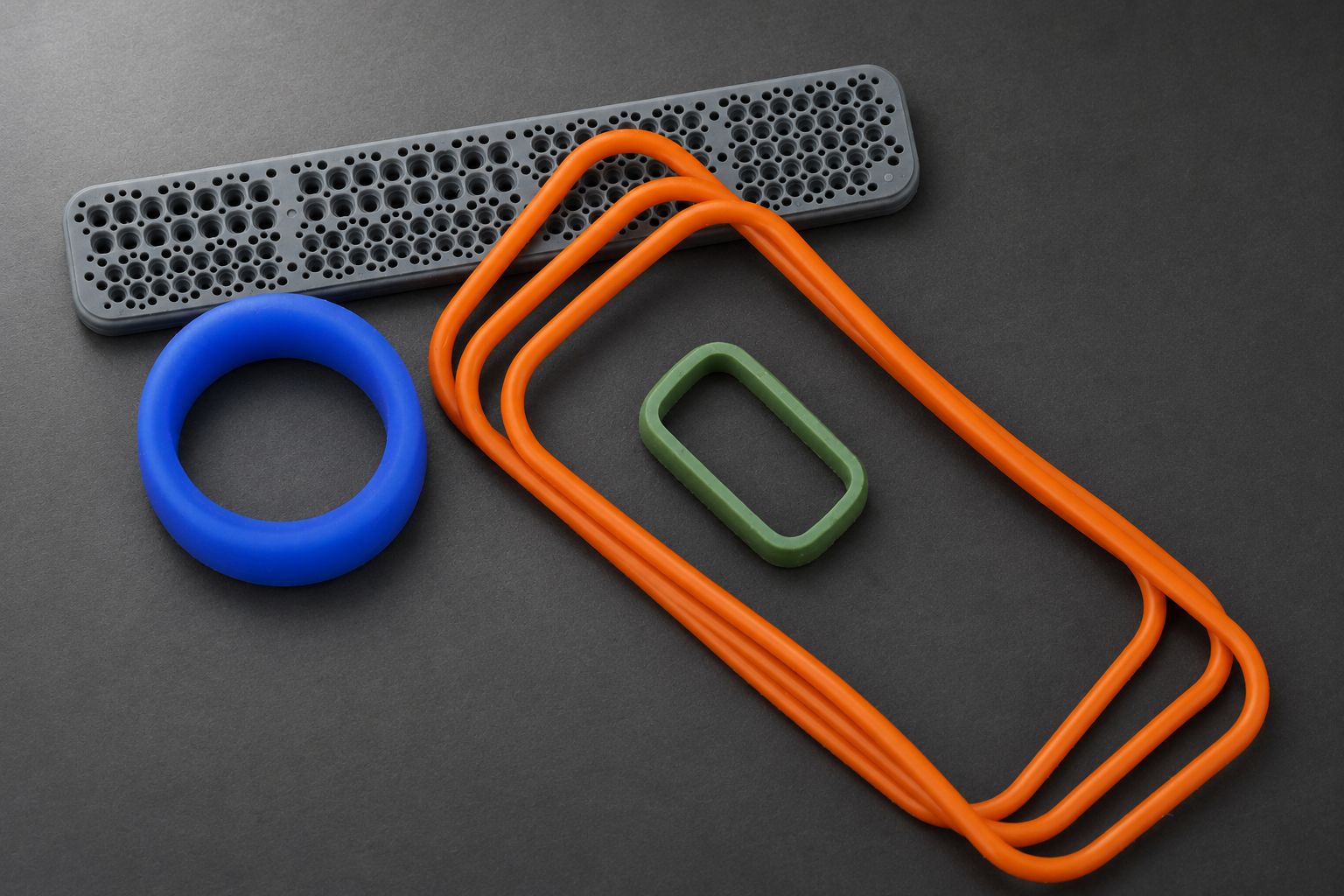
We keep the original housing dimensions as the starting point, then adjust the extrusion profile around them. That means the replacement or upgrade slots into the same footprint without forcing you to rework mounting points, gaskets, or end caps.
Every profile is drawn to the measured cross-section of your current enclosure, including wall thickness, groove positions, and corner radii. Small variances get called out before tooling starts, so the first samples tend to fit on the bench rather than becoming another round of revisions.
From there, we can keep the exterior unchanged while changing internal ribs, LED channels, or cable paths to match what the product actually needs now. The result is a private label part that looks like it came from the same housing family, but performs like a current design.
Tight Tolerances That Cut Out the Usual Leak Fixes
Most leak repairs begin after the fact, with a gasket smeared in sealant or a fitting cranked past its torque spec. Tight tolerances flip that sequence. When mating faces are machined flat within a few microns and bores stay round under load, there is no gap for fluid to find. The seal becomes a byproduct of the geometry, not a bandage applied later.
That changes how parts go together. Instead of relying on thicker gaskets or anaerobic compounds to fill irregular voids, assemblies can use thinner, harder seals that sit in controlled grooves. Clamp load stays even because the flange surfaces are parallel. The usual trail of small fixes—longer bolts, extra washers, re-torquing after heat cycles—gets stripped out of the process.
It also shifts failure analysis. A leak that does appear usually points to a real deviation in machining or assembly, not to a seal that needs more sealant. Maintenance teams spend less time chasing seepage and more time checking the dimensions that were supposed to be right in the first place.
Low Compression Set for Seals That Stay Put
Low compression set means the material resists taking a permanent flat after being squeezed. That rebound is what keeps a seal working once the initial assembly load has settled.
When a seal loses that fight, it doesn't have to crack or tear to fail. It simply stops pressing hard enough into the flange or shaft, and a slow leak begins. Low-set compounds hold more of their original thickness and contact stress through heat cycles and long shutdowns.
For bolted joints and hydraulic fittings, choosing a material with a low compression set can reduce retorquing and prevent the seal from relaxing into a leak path. It is one of the quiet reasons a seal stays put long after installation.
Custom Profiles, Colors, and Hardness Without Long Lead Times
Matching an existing part usually comes down to details that standard catalogs ignore. A specific durometer, tensile requirement, or color target should not force a special production run with a long queue. We keep a wide selection of base polymers and pigment systems ready, and small-batch extrusion is set up to move quickly, so custom profiles can be produced without waiting on tooling that takes months.
Hardness is often the first number people ask for, but it rarely means much on its own. A profile that measures 60 Shore A can still fail if the tear strength is wrong, the surface finish is too slick, or the part lacks a co-extruded sealing bead. We treat material selection and geometry as one decision: the durometer, finish, and any co-extruded features are developed together against actual operating conditions rather than picked from a stock chart.
Color matching does not have to mean accepting a near match. We can match to a physical sample, Pantone reference, or an existing production part, and the approved formulation stays on file for repeat orders. Because the color is compounded into the material instead of applied as a coating, the finished profile holds its appearance through wear, cleaning, and weather exposure.
Quality Checks That Match Your First Approved Sample
Your first approved sample becomes the physical reference point for every run that follows. We keep that sample sealed, labeled, and readily available at the inspection station so each new batch can be compared under the same lighting, angle, and handling conditions. Small deviations in texture, gloss, or edge finish are checked before they ever leave the floor.
Rather than relying on subjective memory, our team works from a short checklist built directly from the approved unit. Measurements, material weight, surface smoothness, and color readings are recorded at first approval, then repeated on production pieces at set intervals. If a result drifts outside the agreed tolerance, the line pauses and the issue is corrected, not documented for someone else to find later.
This keeps your incoming stock consistent with what you signed off on. It also removes the back-and-forth that happens when later batches arrive slightly off. You get the same look, feel, and performance as that first piece you held in your hand.
FAQ
Compounds range from general-purpose silicone to food-grade, medical-grade, and flame-retardant grades, with hardness typically between 30 and 70 Shore A.
Every production lot is tied to a specific material batch, and we use fixed cure cycles plus in-line dimensional checks to catch drift before parts leave the line.
That is possible. A sample, CAD file, or rough sketch can serve as the starting point, and tooling is built to hold the profile within the agreed tolerance.
Most standard formulations work continuously from about -60 degrees Celsius to 230 degrees Celsius, and specialty compounds can extend the upper limit for short periods.
Packaging, labels, and basic branding can be applied to smaller runs. Custom molded branding on the seal itself may require a higher minimum order quantity.
Food and beverage equipment, medical devices, automotive, electronics enclosures, and outdoor lighting are common because silicone resists moisture, UV exposure, and wide temperature swings.
The engineering team can recommend a durometer, profile shape, and lip geometry based on housing design, pressure, movement, and the type of media being sealed.
Simple profiles can often be tooled and sampled within two to three weeks. More complex multi-cavity tools or special material approvals may take four to six weeks.
Conclusion
Private label silicone rubber seals earn their place in assemblies where a generic extrusion just will not do. The material itself is chosen to keep its squeeze over time, so a gasket that starts tight does not turn slack after repeated temperature swings or long shutdowns. That matters because most leaks are not caused by the housing; they come from a seal that slowly gives up its memory. By matching the extrusion profile to your existing housing instead of forcing you to redesign around a stock shape, the seal sits where it belongs from the first install. Tight tolerances also remove the usual workarounds of extra sealant, thicker gaskets, or repeated torque adjustments. A low compression set means the rubber pushes back for years rather than flattening into a dead strip.
Custom profiles, colors, and hardness are handled without making you wait on long tooling runs or overseas sampling cycles. You can specify a durometer that feels right for the load, a color that fits the product line, and a profile that follows the groove exactly, then get production parts that still match the first approved sample. Incoming and in-process checks are tied back to that sample, not to a loose internal standard, so the parts you approved are the parts you receive. The result is a private label seal that quietly keeps doing its job, batch after batch, without requiring you to chase down dimensional drift or change assembly habits.
Contact Us
Contact Person: May
Email: [email protected]
Tel/WhatsApp: 8618027576325
Website: https://www.aobosiliconeparts.com/