

Pharmaceutical Intermediates CRO Services: Streamlining Drug Development with Precision Chemistry
2026-08-10
In the high-stakes race to bring new therapies to market, pharmaceutical intermediates are the unsung heroes that bridge early discovery and commercial production. Yet sourcing and scaling these critical building blocks often derails timelines and inflates costs. That’s where precision-driven CRO services make the difference. At DSL Chemicals, we don’t just supply intermediates—we engineer custom solutions that streamline synthesis, optimize yields, and uphold the strictest quality standards. Ever wondered how the right partner can turn chemistry into a competitive advantage? This blog unpacks the transformative role of specialized CROs in modern drug development.
Precision Chemistry in Early-Stage Synthesis
Early-stage synthesis is where molecules first take shape, and precision at this stage sets the trajectory for everything that follows. Rather than treating initial reactions as rough sketches, chemists now apply exacting control over bond formation, stereochemistry, and functional group placement from the very first step. This mindset eliminates the need for extensive corrections later, shortening development timelines and reducing material waste. By choosing catalysts, protecting groups, and reaction conditions that deliver unambiguous outcomes, teams avoid the cascading errors that often plague scale-up efforts.
One underappreciated aspect is how precision chemistry reshapes the exploration of chemical space. When every intermediate is obtained with high fidelity, researchers can pursue more daring disconnections and non‑obvious scaffolds without fear of intractable mixtures. This encourages the design of compounds that would otherwise be dismissed as too synthetically risky, ultimately expanding the diversity of candidates that reach biological testing. It also simplifies analytical workflows, because clean reactions produce data that is easier to interpret and trust.
Adopting precise methods early also changes the culture of a discovery group. Team members spend less time troubleshooting and more time designing, creating a positive feedback loop where rigorous execution becomes the norm. The initial investment in method selection and optimization pays back repeatedly as projects advance through lead optimization and into preclinical development. In a field where speed and quality often feel opposed, early-stage precision proves they can be mutually reinforcing.
Custom Intermediates for Complex Molecules
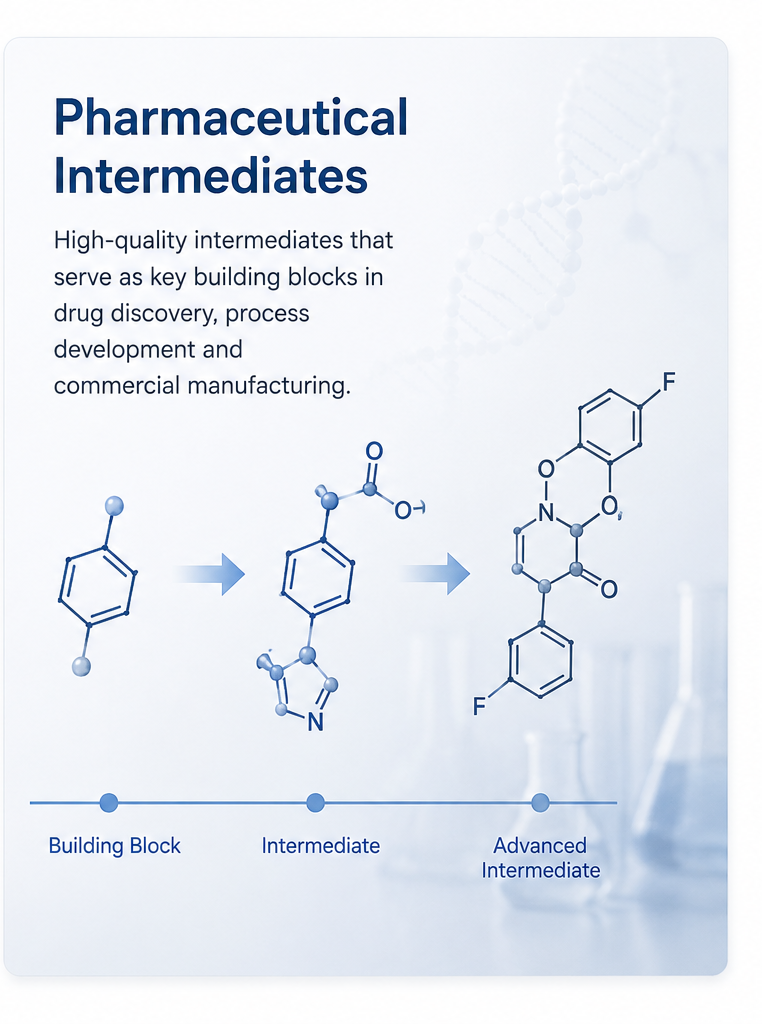
Navigating the intricate pathways of complex molecule synthesis demands intermediates that are not just building blocks, but precision tools. Each intermediate must meet rigorous purity and structural requirements to ensure downstream reactions proceed without costly detours. We focus on designing and supplying these critical components, enabling chemists to bypass typical bottlenecks and accelerate from concept to final compound with confidence.
Beyond off-the-shelf solutions, true synthetic challenges often require bespoke intermediates tailored to unique steric and electronic environments. Our approach combines deep mechanistic understanding with scalable reaction engineering, delivering compounds that integrate seamlessly into your synthetic strategy. Whether bridging a key fragment or installing a sensitive functional group, every intermediate is crafted to maintain momentum in even the most demanding multi-step sequences.
The reliability of an intermediate supply chain can make or break a development timeline. By establishing robust, reproducible routes and maintaining tight control over impurity profiles, we help eliminate the variability that stalls progress. This commitment to consistency allows research teams to focus on innovation rather than troubleshooting, transforming how complex targets are approached from lead optimization through scale-up.
Scalable Processes Without Compromising Quality
Growth often tests the limits of any operation. When you try to do more, the cracks start to show—rushed decisions, missed details, and a creeping sense that what used to be polished is now just passable. The challenge isn’t just adding capacity; it’s designing a framework that bends without breaking. That means looking beyond shortcuts and asking how each step can be refined so volume never dilutes value.
A process that scales gracefully relies on clarity and constraints. Everyone involved needs to understand not just their role but the reasoning behind it, so when pressure mounts, judgment fills the gaps rules can’t cover. At the same time, deliberate limits prevent overload—capping work in progress, batching similar tasks, or enforcing review pauses. These aren’t bureaucratic hurdles; they’re the rhythms that keep quality from being a casualty of speed.
Technology plays its part, but it’s a tool, not a savior. Automation handles repetition so human attention stays on what matters most: creative problem-solving and the subtle improvements no script can predict. Treating metrics as guides rather than verdicts helps maintain perspective, ensuring the push for efficiency never overshadows the original purpose. Resilient growth ultimately comes from respecting the craft while embracing the logistics needed to share it widely.
Accelerated Timelines Through Integrated Services
Bringing every phase of a project under one roof eliminates the delays that happen when multiple vendors hand off tasks. Instead of waiting for separate teams to align their schedules, integrated services allow design, engineering, and execution to overlap intelligently. This parallel processing turns what would be a linear sequence into a streamlined workflow where adjustments happen in real time. The result is a notable reduction in the overall project duration, often making it possible to meet deadlines that once seemed out of reach.
Integration also removes the friction of fragmented communication. When all contributors operate from the same playbook, there's no need to translate requirements between departments or reconcile conflicting updates. Decisions are made faster because the right people are already in the loop, and unexpected roadblocks are spotted early enough to be resolved before they cause setbacks. This cohesive approach naturally accelerates timelines while keeping quality front and center.
Beyond speed, this model builds in efficiency through technology and shared accountability. Centralized project controls and real-time data sharing mean progress can be tracked without endless status meetings. Milestones that once slipped by due to coordination gaps are now met with consistency. The momentum generated by integrated services often creates a compounding effect: as the team gains confidence, the pace actually picks up, delivering outcomes faster than traditional methods would allow.
Regulatory-Ready Documentation and Support
Regulatory demands evolve quickly, often catching businesses off guard with complex documentation requirements. Staying ahead means more than just ticking boxes—it’s about weaving compliance into the fabric of your operations through clear, auditable records that regulators can trust at a glance.
We provide hands-on support that bridges the gap between raw data and submission-ready files, ensuring every detail—down to version histories and signature trails—is captured accurately. Our approach reduces the friction of audits and inspections, turning what could be a stressful scramble into a confident, well-rehearsed process.
By aligning your internal workflows with external expectations, we help you build a documentation culture that not only meets current standards but adapts swiftly to new ones. This proactive stance saves time, protects your reputation, and lets your team focus on innovation rather than paperwork panic.
Collaborative Models That Adapt to Project Needs
Every project carries its own rhythm, its own set of challenges and goals, and the way teams work together should never be one-size-fits-all. The most effective partnerships emerge when collaboration models are designed to flex—when they can shift between highly structured coordination and more fluid, trust-driven exchanges. This adaptability means choosing the right blend of communication channels, decision-making hierarchies, and feedback loops that align with the project’s phase, team dynamics, and intended outcomes. Rather than forcing a prescribed method, successful teams curate a living process that evolves as the work itself changes, ensuring that collaboration never becomes a bottleneck but a genuine accelerator.
Adaptive models often rely on a mix of intentional planning and real-time responsiveness. For instance, a project might start with a tight, centralized approval structure for initial scope definition and then deliberately loosen into distributed ownership as the team gains confidence. The key lies in regularly stepping back to assess what the work demands right now: Is it clarity or creativity? Speed or meticulousness? Autonomy or alignment? By treating the collaboration approach as something that can be recalibrated—through retrospectives, role adjustments, or even temporary task forces—teams sidestep rigidity and maintain momentum even when the unexpected hits.
What truly sets these models apart is their focus on human dynamics over abstract frameworks. They account for varying expertise levels, preferred work styles, and even the subtle shifts in motivation that occur over a project’s lifecycle. This might mean creating quiet spaces for deep individual work alongside vibrant real-time sessions for co-creation, or rotating facilitation roles to keep the process feeling inclusive. Ultimately, a model that adapts is one that listens to both the project’s signals and the people powering it, shaping itself into a natural fit rather than leaving the team to struggle with a misfit structure.
FAQ
Pharmaceutical intermediates CRO services are specialized offerings where contract research organizations handle the synthesis, optimization, and scale-up of chemical intermediates critical to drug manufacturing. Rather than just producing molecules, they bring deep chemistry expertise to solve complex synthetic challenges, ensuring each step from lab to pilot production is seamless and cost-effective.
Precision chemistry focuses on high-yield, high-purity synthesis with tight control over reaction parameters. This minimizes byproducts, reduces purification burdens, and shortens development cycles. By engineering routes that are robust and reproducible, it eliminates the trial-and-error that often slows down early-stage drug development.
Partnering with a CRO gives access to specialized equipment, deep domain knowledge, and flexible capacity without the overhead of building internal teams. It also accelerates timelines since the CRO can rapidly scale reactions that might take in-house groups months to optimize, all while maintaining regulatory compliance and intellectual property security.
Look for a track record in complex organic synthesis, robust analytical support, and a proven ability to scale from grams to kilograms. Equally important is a culture of transparent communication and problem-solving, because unforeseen hurdles always arise. Certifications and a commitment to quality systems should be non-negotiable.
They typically cover a wide range, including heterocyclic building blocks, chiral intermediates, and functionalized scaffolds for APIs. Services often handle challenging transformations like organometallic couplings, enzymatic resolutions, and high-pressure reactions, tailoring approaches to the specific needs of small molecule, peptide, or oligonucleotide therapeutics.
Quality is built in through rigorous process development and in-process controls. Analytical methods like HPLC, NMR, and mass spectrometry are used at every stage to confirm identity and purity. Final products are released against tight specifications, supported by full documentation packages that align with current good manufacturing practices (cGMP) when required.
Conclusion
In the fast-paced world of drug development, pharmaceutical intermediates CRO services are redefining efficiency by combining precision chemistry with end-to-end support. Early-stage synthesis benefits from deep expertise in designing and optimizing routes for complex molecules, ensuring that even the most challenging scaffolds are accessible as reliable custom intermediates. Rather than offering off-the-shelf solutions, these partners invest in understanding the nuances of each project, applying advanced analytical tools and creative problem-solving to deliver high-purity compounds that advance medicinal chemistry programs without unnecessary delays. This tailored approach transforms what is often a fragmented process into a seamless continuum from discovery chemistry to a viable lead candidate.
What sets leading CROs apart is their ability to scale without sacrificing quality, using robust processes that transition smoothly from milligram synthesis to multi-kilogram production. Integrated services—from route scouting and process development to regulatory-ready documentation—collapse timelines and remove the friction of managing multiple vendors. Moreover, collaborative engagement models adapt to the shifting demands of each program, whether that means dedicated FTE support, milestone-based project work, or a hybrid arrangement. By coupling technical rigor with flexible partnership structures, these CROs not only supply intermediates but also act as strategic extensions of in-house teams, accelerating the journey from concept to clinic with consistent, audit-ready quality at every step.
Contact Us
Contact Person: Wei Zhang
Email: [email protected]
Tel/WhatsApp: 862163529955
Website: https://www.dslchem.com