

OEM Stainless Steel Self Tapping Screws for Corrosion Resistant Fastening
2026-11-16
In industries where exposure to moisture, chemicals, or salt spray is a daily reality, standard fasteners rarely survive. Corrosion creeps in, threads seize, and joints fail—often when it's too late. That's why OEM stainless steel self tapping screws are the go-to choice for corrosion resistant fastening. But not all stainless screws are created equal. Wanluo has dedicated years to perfecting these components, ensuring they drill, tap, and hold in the toughest environments. In this post, we'll break down what makes them different, and how to select the right spec for your next project.
Why 316 Stainless Steel Keeps Working When Other Fasteners Give Up
The short answer is molybdenum. While standard 18-8 stainless fights off basic rust, 316 adds roughly 2–3% molybdenum, which rearranges the metal's passive layer into something far more stubborn against chlorides and industrial acids. That means salt spray, road de-icing brine, or the humid breath of a coastal chemical plant won't pit and crack the surface the way it does with lesser alloys. You see it in marine rigging, wastewater treatment hinges, and surgical tray hardware—places where a seized or snapped bolt isn't just annoying, it's a failure that stops the whole job.
But chemistry only gets you so far. What often goes unnoticed is how 316 behaves under sustained load in corrosive environments. Standard carbon steel fasteners fail from the outside in: rust blooms, threads lock, then torque breaks them. 316 stainless, by contrast, tends to fail from the inside out only when improperly heat-treated or machined with contaminated tools. A properly passivated and pickled 316 fastener can sit for decades in a salt-laden atmosphere without losing its preload or turning brittle. That's why harbor cranes and offshore walkways spec it not for the upfront cost, but for the avoided cost of sending someone up in a harness every two years to cut out corroded bolts.
There's also a stubbornness in the field. Walk any dock or wastewater plant and you'll see 316 hardware that's been in service since the 1990s, still turning with a wrench. The threads might show a dull gray patina, but they don't gall, and the nut doesn't weld itself to the stud. That reliability comes from the alloy's balanced nickel and chromium content working with the molybdenum, not against it. It doesn't need a coating that can scratch or peel, no zinc flake to wear through, no cadmium layer to chip at the first impact. In places where a fastener's job is to stay put for the life of the structure, 316 simply refuses to give up the way cheaper grades do.
Self-Tapping Threads That Eliminate Pre-Drilling Without Compromise
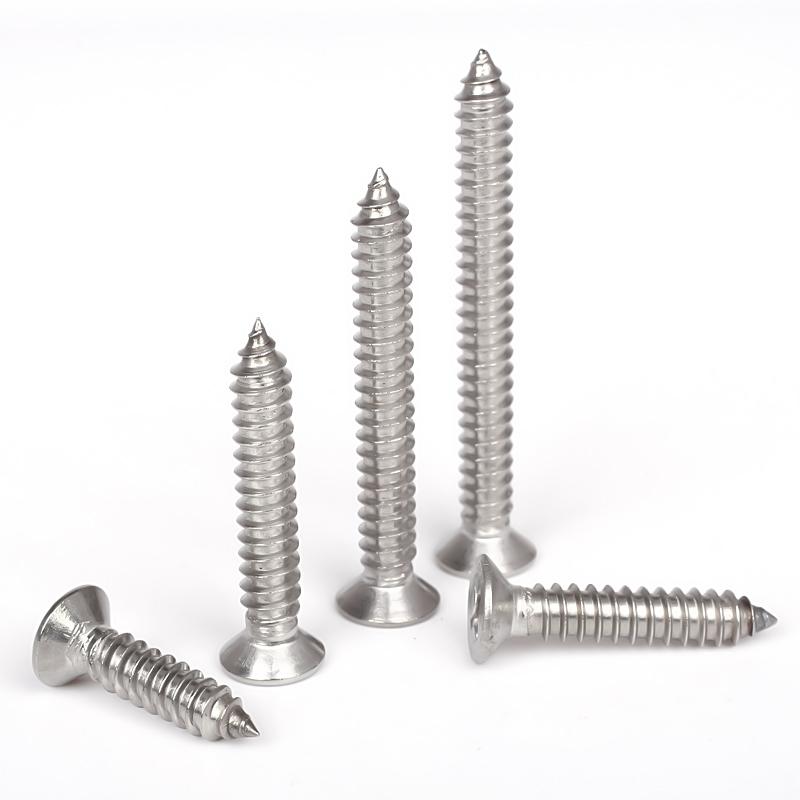
The old habit of reaching for a drill bit before driving a screw dies hard—but it doesn’t have to. These self-tapping fasteners cut their own path through wood, plastic, and light-gauge metal, so pilot holes become optional. The difference is in the thread geometry: a notched tip shears away material cleanly instead of bulldozing through it, which is what usually causes splits or chewed-up edges.
You might expect that skipping pre-drilling means giving up some holding power. That’s where the heat-treated steel and asymmetric thread profile come in. The sharp lead threads bite quickly with minimal torque, then the wider crests behind them lock into the surrounding material. The result feels as tight as a screw seated into a properly sized pilot hole—sometimes tighter, because there’s no clearance gap to begin with.
On the job, that translates to fewer batteries, fewer bit changes, and fewer workpieces ruined by a wandering drill. Installers can move from one fastener to the next without pausing to measure or swap tools. And because the threads are designed to clear chips as they go, the screw doesn’t bind halfway down—even in dense hardwoods where other self-tappers stall.
Custom Head Configurations for Seamless OEM Integration
Every manufacturer brings its own set of requirements to the table, and one-size-fits-all headers rarely fit anyone well. We let you specify the exact shape, pin spacing, materials, and even plating thickness so the connector drops into your existing board layout without forcing a redesign.
Our engineering team works directly with yours to prototype header variations quickly. You get samples that match your mechanical drawings, not a catalog part you have to adapt around. This cuts down the back-and-forth during first article inspection and keeps production timelines from slipping.
Beyond physical fit, custom configurations also cover electrical behavior. We can adjust current ratings, add keying features to prevent misinsertion, or incorporate locking mechanisms that survive vibration-heavy environments. That level of control means your final product keeps its look and function without compromise.
The Passivation Advantage for Aggressive Chemical Environments
In aggressive chemical environments, untreated metal surfaces quickly become vulnerable to pitting, crevice corrosion, and stress cracking. Passivation changes that equation by encouraging the formation of a thin, stable oxide layer that blocks aggressive ions from reaching the base metal. When performed correctly, this process not only extends service life but also reduces the frequency of unplanned shutdowns caused by localized attack.
The real advantage shows up in how passivated surfaces handle halides, strong acids, and oxidizing salts. Unlike coatings that can peel or crack under thermal cycling, the passive film self-heals in the presence of oxygen, maintaining protection even after minor scratches. This makes it especially valuable for pharmaceutical reactors, offshore piping, and chemical storage tanks where a single corrosion failure can contaminate an entire batch or force an emergency repair.
To get the most from passivation, the surface must be free of iron contamination, weld scale, and embedded particulates before treatment. A properly passivated component typically shows a clean, uniform appearance with no visible rust formation after exposure to a salt spray or humidity test. Pairing passivation with electropolishing can further enhance resistance by smoothing micro-crevices where aggressive chemicals tend to concentrate.
Proven Applications from Marine Hardware to Food-Grade Machinery
Stainless steel components rarely get a chance to sit idle. On commercial fishing vessels, deck hardware like cleats, hinges, and fasteners survives constant salt spray and direct impact without pitting or seizing. The same alloy family moves seamlessly into food processing lines, where polished surfaces meet daily washdowns and strict sanitation protocols. One material, two extremes, no compromise.
What makes this range convincing is not just corrosion resistance but predictable behavior under load. Pump shafts in seafood plants turn for thousands of hours without galling, while mixing paddles in dairy tanks hold their finish after years of CIP cycles. Engineers who specify these parts rarely switch back to coated carbon steel once they see the maintenance logs.
Field reports from naval architects and plant managers often echo the same detail: the parts arrive dimensionally stable, install without rework, and stay in service long past the original warranty window. That kind of cross-industry track record does more than sell material—it removes uncertainty from the design phase entirely.
Field-Tested Tips for Avoiding Galling and Maximizing Holding Power
Galling—the nasty welding of threads under pressure—ruins fasteners faster than corrosion ever will. The fix starts before you touch a wrench: scrub both male and female threads with a stiff brush, then wipe with a solvent that leaves zero residue. Even a fingerprint’s oil can cause uneven friction, so keep a box of nitrile gloves on the bench.
Next, pick your lubricant like you’d pick a climbing partner—specific to the load. Anti-seize with nickel or copper works for high-heat exhaust studs, while a moly-based paste suits stainless-on-stainless assemblies. Never use standard grease; it burns off or squeezes out under torque, leaving bare metal to gall.
Finally, slow your speed. Run a drill or impact at full tilt and the heat spikes before the threads seat. Hand-start every fastener, then tighten in short, deliberate pulls. If it starts to feel “gritty” or the torque rises without rotation, back off, clean again, and add a touch more anti-seize. That extra thirty seconds beats drilling out a snapped bolt at midnight.
FAQ
They can, if you select 316 stainless and passivate the threads after machining. The passivation removes free iron and lets the chromium oxide layer reform, which is what really keeps rust at bay. For constant immersion, we also suggest a slightly larger pilot hole to reduce stress on the material.
Aluminum is lighter, but it galls easily and its corrosion resistance tanks when it touches carbon steel or certain treated wood. Stainless stays much closer to neutral on the galvanic scale for most construction and marine fittings, and the self-tapping thread cuts cleaner in thicker plastics and sheet metal.
Custom heads are a big part of OEM work. We have supplied pan, flat, hex washer, and even tamper-resistant Torx with a slightly undercut head for flush seating. Send over a drawing or a sample and we can match the recess depth and drive fit.
Most breaks happen from too high RPM or the wrong pilot hole. Slow the drill down to around 800 to 1200 RPM, drill a pilot that is about 70% of the minor diameter, and use a clutch if you have one. The stainless work-hardens, so steady pressure beats forcing it.
It depends on the alloy and how much cold working the thread has seen. 304 and 316 are generally non-magnetic in the annealed state, but after thread rolling they may show a slight pull. If non-magnetic matters for your application, we can specify a low-carbon 316L and anneal after forming.
The standard finish is a clean, degreased surface with optional passivation. If the photos look matte, that's usually the passivated or lightly tumbled finish. We also offer a bright polish for cosmetic parts and a black oxide-like coating that is actually a thin ceramic layer for discreet fastening.
Yes. The standard self-tapping thread is great for medium gauges, but for thin sheet metal we can switch to a finer pitch with a sharper point, and for softwoods we use a wider, more aggressive thread that clears chips better. Minimum order quantities for custom pitch are lower than you might expect.
Zinc-plated steel will rust once the plating is scratched, and that scratch becomes a starting point for corrosion under the coating. Stainless doesn't rely on a sacrificial layer, so even if the surface gets marred, the exposed area still resists oxidation. You pay more up front, but you avoid the red rust streaks on teak or cedar.
Conclusion
For OEM buyers who need fasteners that survive where others corrode, 316 stainless self-tapping screws are the quiet workhorses. The material itself resists pitting and crevice attack from chlorides and industrial chemicals, which is why marine hardware, food processing lines, and chemical washdown equipment keep specifying them year after year. But the real edge comes from pairing that alloy with a thread geometry that cuts its own path — no pre-drilling, no secondary operations, just a clean bite into sheet metal, plastic, or thin-gauge stainless. When the head configuration is tailored to your assembly process, whether that’s a low-profile countersink for flush panels or an undercut flange for load distribution, you stop fighting the fastener and start designing around it.
Passivation takes the corrosion story one step further by removing free iron from the surface and letting the chromium oxide layer form undisturbed, which matters when you’re bolting together components that get exposed to aggressive cleaning agents or salt spray. In the field, operators learn quickly that galling is the enemy, especially with stainless-on-stainless joints, so slowing down driver speed, using a proper lubricant, and avoiding over-tightening become second nature. The result is holding power that doesn’t rely on thread-locking compounds or oversized holes — just a well-chosen screw doing its job in places where a standard zinc-plated fastener would be scrap within a season.
Contact Us
Contact Person: Shane
Email: [email protected]
Tel/WhatsApp: 8613357785029
Website: https://www.wanluohardware.com