

OEM Pet Hardware Essentials for Durable Pet Product Lines
2026-11-02
When it comes to durable pet product lines, the hardware often tells the real story. Collars, harnesses, and leashes live through mud, rain, and daily tugs—so every OEM buckle, D-ring, and snap has to earn its place. Kingming has spent years refining those small but critical parts, and this guide covers the essentials to help your products outlast the competition and win loyal pet parents.
What Actually Breaks First on a Cheap Leash
The first thing to go is almost never the leash fabric itself—it's the hardware. The swivel snap hook or bolt snap is usually made from cheap zinc alloy or thin stamped metal. After a few weeks of clipping and unclipping, the spring inside loses tension or the gate starts sticking. Once that happens, a sudden lunge can pop it open. I've seen clamps bend out of shape just from a dog shaking off water.
Next in line is the stitching where the handle loop is formed. On many budget leashes, this seam is only double-stitched with lightweight thread. Constant hand pressure and the occasional tug create tiny tears in the thread. It doesn't snap loudly; it just unravels one loop at a time until the handle gives way. If the leash has a padded handle, that's even more likely, because the padding hides the failing stitches.
Also watch the point where the webbing meets the metal ring or clasp. That junction takes the most torque. Cheaper leashes often use a single box stitch or a simple fold-over with a few lines. When wet, nylon can slip slightly, and the friction against the metal edge eats through the fibers. The result is a frayed tongue of fabric that looks fine until it isn't.
Choosing Metal Finishes That Won't Flake After One Rainy Walk
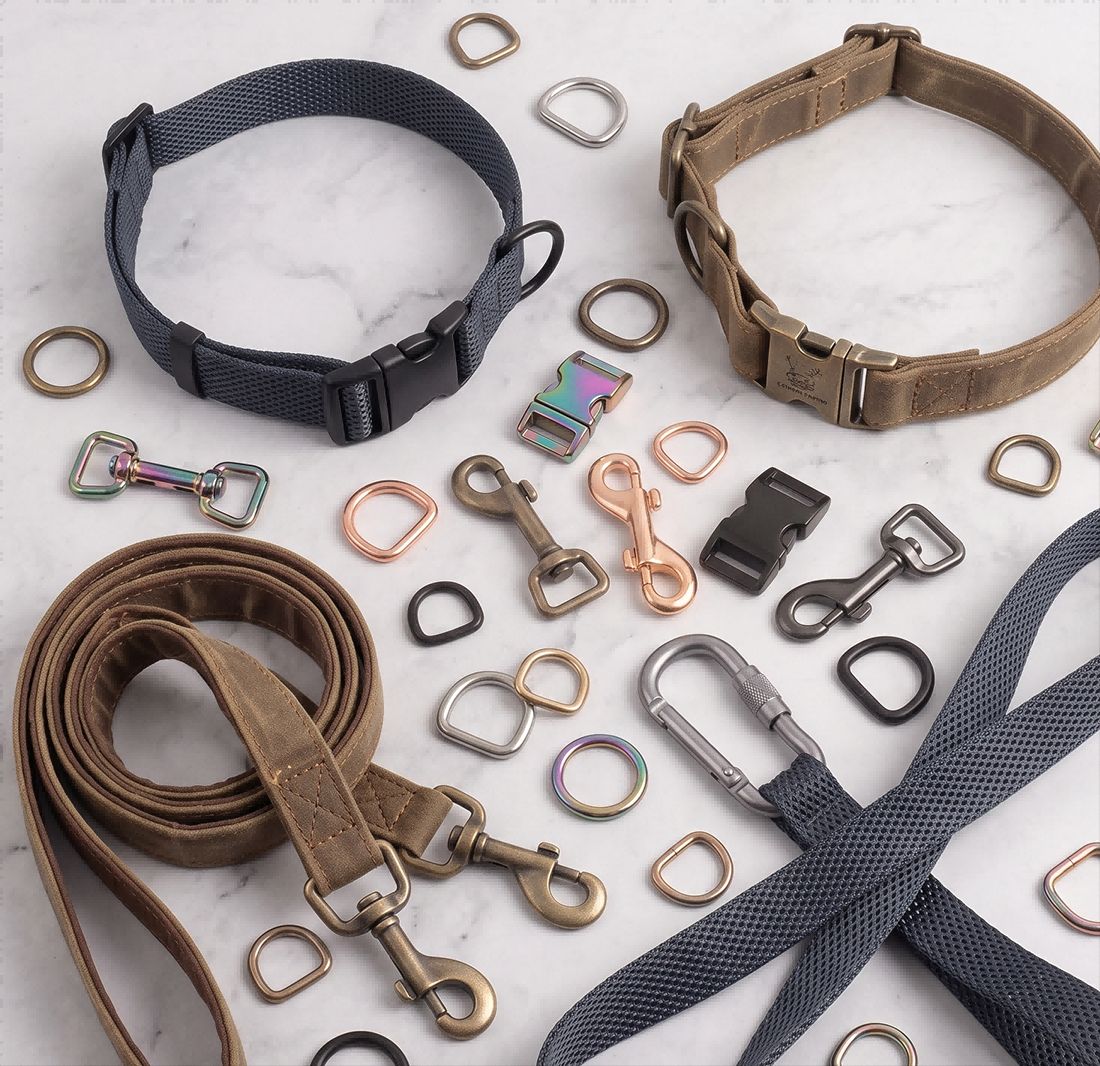
Most flaking happens because moisture sneaks under the coating through microscopic pores or edge wear. Look for finishes applied with physical vapor deposition (PVD) or a multi-layer electroplating process that includes a nickel underlayer before the final color. These bond to the base metal rather than sitting on top like a thin lacquer, so they handle flexing and temperature swings without cracking. Cheap single-layer flash plating or 'vacuum metallized' plastic hardware almost always starts peeling at corners after the first wet outing.
When you're comparing pieces, run a fingernail along any engraved edges, clasps, or zipper pulls—those are the first places rain works its way in. Ask about salt spray testing; a finish rated for 48 hours or more will survive far more than a drizzle. For lightweight parts, anodized aluminum is tough and won't peel because the color is grown into the oxide layer, not painted on. And if you want a finish that ages gracefully, choose an intentional antiqued or matte texture over a high-polish mirror, because the first tiny scratch won't reveal a bright line of raw metal underneath.
The Buckle Test Most Factories Skip
Walk into any factory that stamps metal buckles, and you'll see rows of gauges checking thickness, width, and hole alignment. What you almost never see is a technician twisting the buckle under repeated off-axis load until the prong starts to yawn. That omission isn't laziness — it's a quiet bet that the real world won't put much torque on a belt. But the first time a worker leans over a conveyor and snags a buckle on a rail, that bet loses.
The test itself is brutally simple: clamp the frame, thread a fabric strap through the prong, and pull at a 15-degree angle a few thousand times. Most dies pass the straight-pull fatigue test with flying colors. The off-axis version separates the designs that survive a decade of daily wear from the ones that develop a hairline crack near the hinge after three months. Factories skip it because it's slow, because the setup is fiddly, and because no purchase order explicitly demands it.
But skipping it creates a blind spot that no amount of polishing can cover. A buckle can look flawless under studio lights, pass every dimensional check, and still fail on a job site where belts get twisted in tool belts or caught on ladder rungs. If your supplier can't show you a fixture for angled cyclic loading, you're not buying a proven component — you're buying a hopeful one.
OEM Hardware Specs You Should Never Accept as Good Enough
Most OEM desktops look decent on paper until you open the case. The power supply is often a no-name 300W unit with just enough connectors for the build that shipped, no PCIe power for a future GPU, and proprietary motherboard headers that make swapping it a nightmare. The motherboard itself usually uses the cheapest VRM design available, with two RAM slots, no heatsinks on the power delivery, and a BIOS so locked down you can't even enable XMP profiles. These aren't minor annoyances; they set a hard ceiling on performance and longevity.
Memory and cooling get the same cost cutting treatment. A single stick of DDR4-2666 in single-channel mode can easily cost you 15-20% CPU performance in memory-sensitive workloads, yet OEMs keep shipping it because most buyers never check. The stock cooler is often a small aluminum block with a fan that ramps up like a jet engine under sustained load, throttling the CPU after a few minutes of real work. Storage is another trap: you'll see a 512GB NVMe SSD, but it's usually a DRAM-less QLC drive that slows to hard drive speeds once the SLC cache fills.
Then there's the chassis itself. Tight proprietary layouts, zero extra drive bays, soldered Wi-Fi modules, and front I/O that only works with the original motherboard. Upgrading one component often means replacing three others. If you're buying an OEM system, budget for a new PSU, a second RAM stick, and a better cooler from day one—or just build it yourself and avoid the headache.
Why a 100-Pound Dog Needs a 500-Pound D-Ring
Most dog owners assume a sturdy leash and a well-fitted collar are enough for any dog, but when you have a 100-pound powerhouse, the weakest link is often the hardware. A standard D-ring rated for 50 or 75 pounds can bend, snap, or fail under sudden force—a squirrel darting across the street, another dog lunging, or your dog simply deciding to pull with all his might. The math is uncomfortable: a dog's pull force can easily exceed twice his body weight in a burst, and a 100-pound dog can generate over 200 pounds of pressure in a split second. That's why a 500-pound D-ring isn't overkill—it's a safety margin that accounts for shock load, wear and tear, and the unpredictable nature of large, strong dogs.
Cheap hardware often fails at the weld or the ring itself deforms under pressure, leaving you holding a leash attached to nothing. A 500-pound D-ring, typically forged from solid steel or heavy-duty zinc alloy, distributes force evenly and resists bending even when your dog bolts at full speed. It's not about distrusting your training; it's about acknowledging that any dog, no matter how well-behaved, can have a moment of pure instinct. The stronger the ring, the less likely you are to face a sudden escape, a lost dog, or a dangerous situation near traffic.
Beyond safety, there's a practical side: the same D-ring that holds a leash should also handle a tie-out in the yard, a car restraint, or a tether at a campsite. A 100-pound dog leaning against a tied rope can generate steady pressure well over 500 pounds over time, especially if he lunges or jumps. Investing in a heavy-duty D-ring means you only buy once, instead of replacing bent or cracked hardware every few months. It's a small, often overlooked piece of gear that makes a massive difference when it matters most.
Designing for the Dog That Pulls Like a Tractor
Some dogs don't just lean into the leash—they commit their entire body weight, every muscle firing, as if they're trying to uproot a fence post. Designing gear for these canine tractors isn't about adding more padding or thicker webbing. It's about understanding the physics of a sudden lunge and the way force travels through a harness, then rethinking anchor points, load distribution, and the materials that can handle repeated shock loads without failing or chafing.
A dog that pulls like a tractor needs a harness that works like a suspension bridge, not a straightjacket. Wide, contoured straps spread pressure across the chest and sternum instead of concentrating it on the trachea. Reinforced stitching at the girth and belly straps prevents blowouts during a squirrel sighting. And the leash attachment? It has to sit lower on the back or chest, giving you a mechanical advantage that turns a full-body drag into a manageable redirect.
Real-world testing means walking a 90-pound Labrador who ignores every 'heel' command while you brace against a fire hydrant. If the hardware rattles, the straps shift, or the handle digs into your palm after two blocks, it's back to the drawing board. The best designs for relentless pullers are the ones that feel invisible until the moment they save your shoulder—and then they simply hold, without drama, every single walk.
FAQ
Load-rated side-release buckles, welded D-rings, and smooth-edged triglides are the backbone. Avoid cast zinc parts with visible parting lines—they tend to crack under sudden pulls. Ask suppliers for cyclic load test reports rather than just static pull numbers.
Zinc alloy is cheap but heavy and can corrode around saltwater. Stainless steel is the go-to for strength and rust resistance, though it costs more and adds weight. Acetal is lightweight and quiet, ideal for small dogs or cats, but check UV stabilizers if it will live outdoors.
Most OEM factories start around 500 to 1,000 units per SKU for custom colors, and 2,000 to 5,000 for molded logos. Lower quantities usually mean higher unit cost or limited color matching. Always ask for a pre-production sample before the full run.
Ask for UV-stabilized nylon or acetal grades and a QUV accelerated weathering test report. For coated metal parts, request a cross-hatch adhesion test result. Avoid solvent-based paints—powder coating or anodizing holds up far better on high-wear contact points.
The weld on D-rings and the spring inside side-release buckles fail most often. Specify laser or TIG welding instead of spot welding for rings, and ask for a minimum 10,000-cycle actuation test on buckles. Also check that the buckle tongue fully seats—partial engagement causes stress fractures.
Fully assembled sets save time and reduce mismatched tolerances, but you lose some flexibility. If your line has multiple strap widths, consider sourcing webbing-compatible hardware sets where the supplier guarantees fit across all widths. Otherwise, mixing pieces from different factories often leads to rattling or binding.
Rounded edges, flush seams, and a subdued surface finish—like matte anodizing or soft-touch overmolding—signal quality. Avoid glossy chrome plating on high-wear zones because micro-scratches show quickly. A subtle deboss or laser-etched logo adds brand presence without the fragility of raised lettering.
Conclusion
Most cheap leashes fail at the same handful of stress points long before the webbing shows wear. The stitching near the clip unravels, the snap hook develops a hairline crack, or the plating starts flaking after a single wet walk. If you are sourcing OEM hardware for a durable pet line, start by asking suppliers where their leashes actually break. The answer should be nowhere under normal use. Metal finishes matter more than they look: a zinc die-cast clip with a thin nickel coat will corrode at the hinge and leave rust stains on fabric within weeks. Ask for salt spray test reports, not just a shiny sample. And do not skip the buckle test most factories ignore: load the buckle from the side, twist it while under tension, and cycle it a few hundred times. A buckle that passes a straight pull but pops open when the leash twists is a warranty claim waiting to happen.
OEM hardware specs are where durability gets quietly compromised. A spec sheet that only lists metal alloy or nickel plated is not good enough; you need exact grade, plating thickness, and load rating per component. For a 100-pound dog, a D-ring rated at 100 pounds is a failure point, not a safety margin. Dogs lunge, jerk, and twist, so the D-ring should hold at least five times the dog's body weight, usually 500 pounds or more. Designing for the dog that pulls like a tractor means choosing forged hardware over cast, oversized rivets, and testing the entire assembly, not just individual parts. The leash is only as strong as the weakest connection between the handle and the clip.
Contact Us
Contact Person: Jamie Zeng
Email: [email protected]
Tel/WhatsApp: +86 13728219269
Website: https://www.kmhardware.com