
ODM Chrome Wire Mesh Trolley Designs That Improve Storage and Mobility
2026-11-27
Storage bottlenecks rarely announce themselves—they show up as slower picking, dented wire shelves, and trolleys that fight you on every turn. That’s exactly where ODM chrome wire mesh trolley designs earn their keep. By combining corrosion-resistant chrome finishing with open mesh visibility and purpose-built mobility features, these trolleys hold more than inventory: they shorten daily routes and keep operations moving. ZEOU has been refining that balance between capacity, airflow, and maneuverability for real warehouse conditions. Ahead, we’ll look at the design details that separate a forgettable cart from one your team actually reaches for.
Open-Wire Mesh That Keeps Stock Visible During Busy Shifts
The open-wire design on this unit does more than hold product; it keeps sightlines clear from the front aisle to the back stock area. During a lunch rush or a packed evening, staff can glance over and immediately see which shelves need refilling before customers have to ask. That visibility cuts down on unnecessary trips behind the counter and helps the whole team stay a step ahead of demand.
Because the mesh allows light and air to move through, the display never feels like a solid wall closing off the space. Inventory stays organized and easy to reach, while the wire construction gives just enough structure to keep boxes and loose items from shifting. For busy shifts, that mix of openness and containment means restocking happens faster and the sales floor keeps its rhythm.
Low-Profile Chrome Frames That Fit Under Standard Workbenches
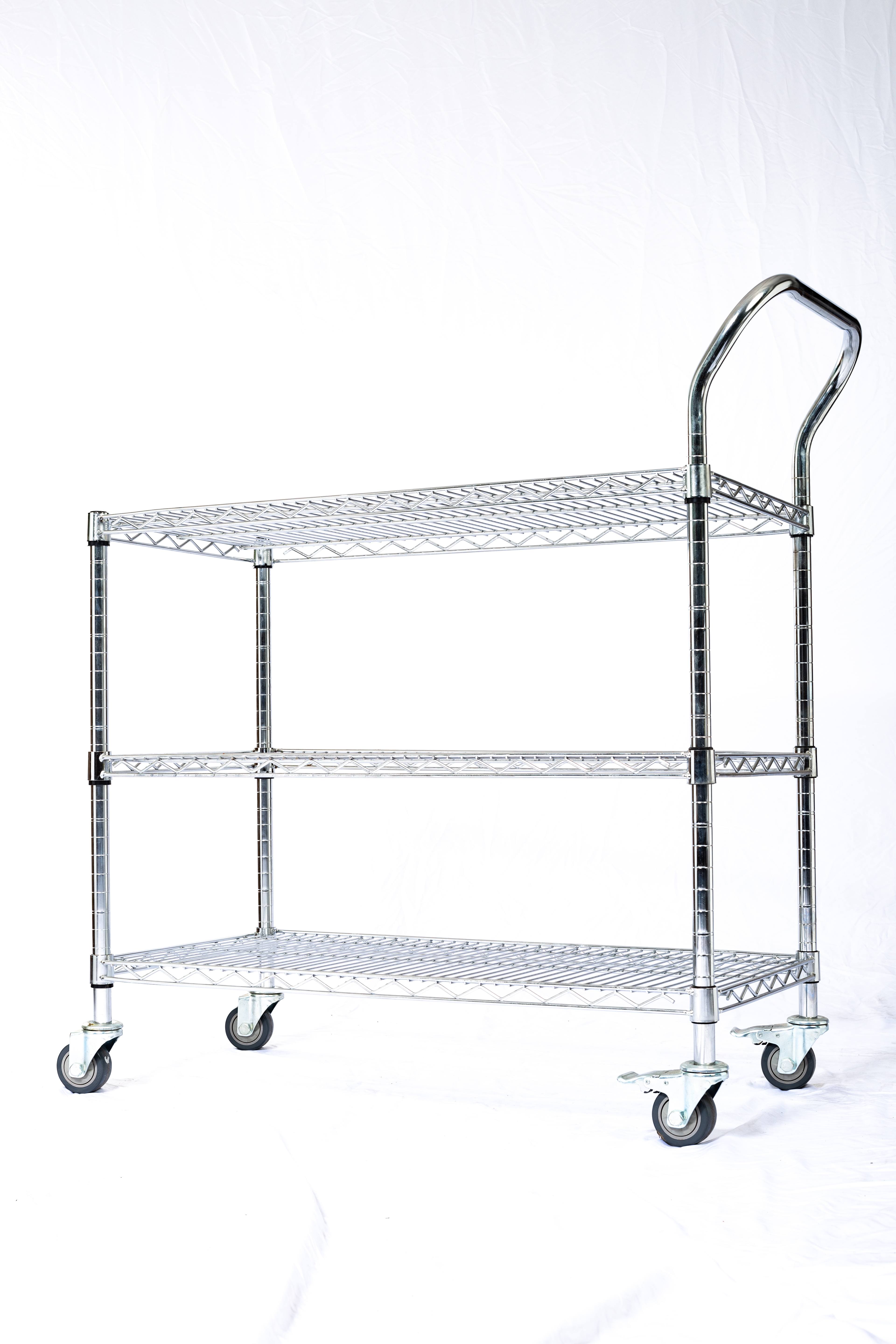
Most standard workbenches leave a narrow band of unused space between the bottom shelf and the floor, usually just enough for a low-profile frame to slide underneath without blocking foot room. These chrome frames are deliberately kept shallow, so they tuck past the legs and still allow the bench to sit flush against a wall or workstation row.
The chrome finish is more than a visual match for existing wire shelving. It holds up against moisture, oils, and the occasional scuff from boots or carts, and it wipes down without leaving smudges. Because the frame sits close to the ground, the open wire design keeps dust from building up in corners while still giving small bins, spray bottles, or flat trays a stable place to rest.
Fit matters most at the leg openings and under the crossbars. A well-sized low-profile frame should clear the bench's lower structure by at least a fraction of an inch on all sides, and the feet should sit level without rocking on uneven concrete. If the height works, the under-bench area becomes usable storage that would otherwise collect clutter or stay empty.
Swivel Casters With Locking Brakes for Tight Aisles
Maneuvering a loaded cart through a narrow warehouse aisle usually means choosing between bumping into racking and making a dozen awkward corrections. Swivel casters change that calculation. The wheels rotate a full 360 degrees under the load, so the cart can pivot in place or slide sideways into a tight spot without forcing you to back up, swing wide, or wedge yourself against shelving.
The locking brakes are what make that agility truly usable. Once the cart is exactly where you want it, stepping down the brake tabs keeps both the wheel and the swivel from moving. That matters a lot on slightly uneven floors or when someone needs to load or unload heavy boxes, because a cart that drifts even a couple of inches in a tight aisle can block the path or create a pinch point.
For tight-aisle work, a stiffer caster isn't always better. A responsive swivel head with a brake that engages cleanly gives you more control than oversized wheels that struggle to turn in small spaces. Look for a tread that won't chatter on concrete and a brake mechanism that can be operated from a standing position, so repositioning the cart doesn't turn into a balancing act.
Adjustable Shelves That Handle Mixed Carton Sizes
Most racking systems fall apart when carton dimensions start to vary, but the real test comes when a single pick face needs to hold both slim shoe boxes and bulky appliance cartons on the same day. The trick isn't just about moving a beam up or down a few inches. It's about beam profiles that allow quick repositioning without unloading the entire bay, and uprights with punched teardrop holes tight enough to hold position under repetitive forklift impact yet open enough for a gloved hand to make changes in under a minute.
A well-designed adjustable shelf setup treats mixed carton sizes as the default, not the exception. Look for shelves that can be set at different depths along the same bay, creating a stepped profile so that shallow boxes don't get buried behind deeper ones. The front-to-back adjustability matters just as much as vertical changes. When your inbound receiving shifts from flat-pack furniture one week to small hardware bins the next, the ability to re-space three or four levels during a lunch break keeps put-away and picking speeds from cratering.
Operator behavior also changes once the shelving stops fighting them. Instead of stacking odd-sized cartons on the floor or jamming them into gaps that don't fit, workers start placing items at their natural home. That reduces product damage and cuts the time spent searching. The best adjustable systems don't advertise themselves—they just disappear into the background because every carton, regardless of footprint or height, lands on a surface that was set for it an hour ago.
Nesting Trolleys That Fold Away When Not in Use
A trolley that disappears into a slim gap when the shift is over changes the way a stockroom or shop floor breathes. These nesting designs use a hinged or collapsible frame so the baskets or shelves sit close together, and the whole unit can be rolled into a corner, behind a door, or against a wall. What makes the difference is that folding them takes a few seconds and no tools—just release a latch, lift a handle, or push the sides inward.
The real advantage shows up in busy spaces where an empty cart usually ends up blocking a fire exit or cluttering a narrow aisle. Because one folded trolley takes up a fraction of its working footprint, several units can live in the space that previously held one. That also means staff spend less time hunting for spare carts at the start of a shift and less time rearranging them mid-shift.
Durability still matters when the frame moves more often. Look for reinforced pivot points, wheels that stay steady on uneven floors, and a locking mechanism that stays firm without sticking. A well-designed folding trolley should feel sturdy when open and almost effortless to collapse, with no need to line up stubborn catches or fight a warped shelf.
Rounded Corner Guards That Protect Doors and Equipment
Dents and chipped paint around a loading dock or storage room rarely come from a single major collision. More often they build up over time from carts, gurneys, pallet jacks, and everyday foot traffic catching the same edge. Rounded corner guards absorb that contact before a door frame, cooler panel, or machine housing takes the hit. The low-profile curve lets equipment glance off instead of digging in, which keeps stainless steel, wood, and powder-coated surfaces looking intact far longer.
The advantage of a rounded profile goes beyond appearance. Flat or square guards can still catch a wheel or snag a passing load, but a smooth radius pushes moving objects away with less resistance. Many facilities fit these along doorways, column bases, and corners of diagnostic or processing equipment where clearance is tight. Because the guard flexes on impact and returns to shape, it does not transfer the full force into the wall or frame behind it. Maintenance teams spend less time patching drywall, repainting trim, and replacing damaged corner bead.
Installation tends to be straightforward, usually with industrial adhesive or screws, and the guards can be trimmed to match uneven floor lines or custom equipment profiles. High-visibility colors also help mark a boundary that might otherwise go unnoticed until an accident happens. For busy corridors, cold storage areas, and equipment rooms, that combination of protection and visual warning makes a rounded guard a practical upgrade rather than just a cosmetic cover.
FAQ
The open grid keeps dust from settling on stored goods and lets staff check contents at a glance. The chrome plating also holds up well against scuffs and damp conditions, so the units stay presentable even with daily handling.
A combination of swivel castors at the front and fixed castors at the rear gives the trolley a predictable turning arc. That makes it easier to steer around corners without the load swinging wide, especially when carts are fully loaded.
The mesh allows air to circulate around stored items, which helps prevent condensation from building up in cooler storage areas. It also keeps small parts from slipping through while still giving a clear line of sight to labels and bin locations.
With an ODM build, the shelf spacing, handle height, and overall footprint can be matched to the exact crates or cartons a business already uses. That removes the usual compromises around pack size and aisle width.
Larger rubber wheels with a bit of tread absorb more vibration than hard nylon castors, and a spring-loaded or reinforced fork helps the trolley roll over small gaps without jarring the frame. Brakes on at least two wheels keep it steady during loading.
Yes. A thicker chrome layer or an added clear sealant gives the wire extra resistance to moisture and mild cleaning chemicals. Some facilities also request stainless steel reinforcements at the corners and base for longer service life.
Workers can see stock levels from several angles without stopping to open drawers or shift containers. That cuts the time spent on cycle counts and makes misplaced items much easier to spot during a walkthrough.
Look at the weld points where the mesh meets the frame, the thickness of the bottom grid, and whether the uprights are reinforced with a second bar. Those details matter more than the overall weight, because they determine how the cart behaves under a full load.
Conclusion
The open-wire mesh construction on these ODM chrome trolleys keeps cartons, bins, and supply items visible through the busiest parts of a shift, so staff spend less time hunting and more time moving. Instead of bulky frames that force teams to work around them, the low-profile chrome chassis slides under standard workbenches, which frees up floor space without cutting capacity. Adjustable shelves add real flexibility for mixed carton sizes, holding a tall morning stack just as securely as a scattered afternoon pick. Because the wire panels are welded into the frame rather than bolted on, the whole unit stays rigid even when it rolls across uneven thresholds, takes a hard turn, or gets loaded unevenly.
Mobility gets the same level of attention as storage. Swivel casters with locking brakes let the trolley pivot through tight aisles and then hold position at a packing station, so it does not drift while someone reaches for the top shelf. When floor space is short, the nesting design folds the trolleys together and parks them against a wall or inside a closet until the next wave of orders arrives. Rounded corner guards prevent scraped door frames, dented equipment housings, and the sudden stops that jostle fragile stock. Together, those details make the trolley fit the rhythm of a busy stockroom or retail floor instead of demanding special handling.
Contact Us
Contact Person: Alin
Email: [email protected]
Tel/WhatsApp: +86 15015291051
Website: https://zeoumetal.com/