
MCM Interior Wall Covering: How a Powerful Manufacturer Elevates Your Design
2026-09-01
You’ve spec’d the furniture, the lighting, the flooring—then the walls become an afterthought. That’s a missed opportunity. MCM interior wall covering can carry the entire design story, especially when it comes from a manufacturer that treats production as part of the creative process. Magic Stone doesn’t just supply panels; they engineer surfaces that respond to light, texture, and scale in ways that make a room feel intentional. Here’s what happens when manufacturing muscle meets design ambition.
The Material Shift That Lets Walls Move Beyond Flat and Boring
For decades, drywall and a fresh coat of paint set the default. But a quiet shift in interior materials is changing that. Lime plaster, tadelakt, and clay finishes bring subtle movement and depth that flat latex never could. Their slight irregularities catch light differently throughout the day, making a room feel alive rather than simply painted.
The change isn't limited to traditional plasters. Engineered panels with sculpted reliefs, cork sheets, and recycled felt tiles offer both texture and acoustic benefits. Even large-format porcelain slabs now mimic raw stone, concrete, or weathered metal with enough surface variation to trick the eye and the hand. These aren't decorative afterthoughts; they're becoming the wall itself.
What makes this shift stick is the move away from uniformity. Designers are spec'ing materials that reward touch and close inspection. A wall with grain, undulation, or a soft edge does more than fill space—it shapes how a room feels. The result is interiors that look less like showrooms and more like places with their own quiet character.
What Happens When a Manufacturer Invests in Its Own Color Matching Lab
Opening an in-house color matching lab changes how a manufacturer handles every shade and finish. Instead of sending samples back and forth to an outside vendor, the team can test pigments, adjust formulas, and approve final colors on the same day. This cuts down the weeks usually lost to shipping and miscommunication, giving the production floor a steady rhythm that doesn't stall over a pantone code.
The lab also becomes a place where subtle variations get caught before they turn into costly batch rejections. Technicians can run small trial mixes under different lighting conditions, compare them against reference tiles, and document what works. Over time, this builds a searchable library of reliable recipes, so repeat orders match perfectly without guesswork. It's a quiet shift from relying on someone else's eye to owning the entire color journey.
There's a longer-term payoff too: the ability to experiment. With the equipment on site, designers and material engineers can push into custom hues or metallic effects that a third-party service might shy away from. That freedom often leads to product lines that stand out on a shelf, simply because the manufacturer stopped treating color as an afterthought and started treating it as something worth mastering in-house.
Why MCM Turns Tricky Renovation Sites into Manageable Install Days
Most renovation projects come with a list of unknowns: outdated wiring behind plaster, load-bearing walls that weren't on the original plans, or delivery windows that shift without notice. MCM approaches these realities without flinching. Instead of treating tricky sites as exceptions to a standard process, we treat them as the rule. That means every install begins with a detailed pre-construction walkthrough, where our team identifies potential friction points before tools ever hit the job site.
Once the scope is clear, the work comes down to sequencing. We coordinate material staging, trade schedules, and site access so that no one is waiting on someone else. If a wall opens up and reveals an unexpected pipe or conduit, our installers have the authority to make field adjustments on the spot, document the change, and keep the day moving. That decision-making power is what separates a calm install from a chaotic one.
By the time the client walks through the finished space, the tricky parts are already behind the drywall. They don't see the problem-solving, the real-time calls, or the extra coordination that went into keeping the schedule intact. They just see a clean finish and a day that didn't spiral. That's the point. MCM turns what could be a renovation headache into a manageable, predictable install day.
The Hidden Engineering Behind Lightweight Panels That Feel Substantial
Most people assume heft equals quality, but the real story behind panels that feel solid is less about raw weight and more about how vibration travels through the material. Manufacturers often use a constrained-layer damping approach, where a thin viscoelastic sheet is sandwiched between two stiffer skins. When you tap the surface, that middle layer converts kinetic energy into tiny amounts of heat instead of letting it bounce back as a hollow ring. The result is a dull, dense thud that your brain reads as expensive and robust.
Another trick is strategic mass loading in specific zones rather than across the whole panel. By adding small weights or denser inserts near corners and edges, engineers shift the panel's resonant frequency below the range where human touch and hearing are most sensitive. This doesn't just change the sound; it alters how the panel deflects under finger pressure, giving it a firm, almost ceramic stiffness. Even thin panels can feel thick if the edge return is designed with a slight radius that resists flexing.
Core structure also plays a quieter role. Instead of solid slabs, many premium-feeling lightweight panels use a honeycomb or foam core with micro-perforated facings. The tiny perforations break up standing waves inside, eliminating the empty drum effect without adding grams. Combined with a soft-touch top layer that has slight compressibility, the entire assembly mimics the tactile response of a much heavier board, all while keeping shipping costs and material use low.
From First Sample to Final Walkthrough Without the Usual Runaround
You send over a rough idea, a sketch on a napkin, or just a frustrated email about what isn't working. Within a day, a physical sample lands on your desk. Not a digital mockup, not a promise—an actual thing you can hold, bend, drop, and hand to the person who has to live with it every day.
Changes come back marked in pen, sometimes with a sticky note that says "too heavy" or "edge catches on sleeve." We don't schedule a meeting to discuss the meeting. We just fix it, re-run the sample, and ship the next version. Most projects see two or three rounds before you stop finding things to complain about—that's the signal to move forward.
The final walkthrough happens on your floor, with your team, using your actual equipment. If something feels off, we stand there until it's right. No ticket queues, no handoff to a different department, no week-long silence. You get one contact who knows your part better than you do by the end, and a finished piece that doesn't need a rework sticker.
Curved Walls, Tight Corners, and Other Details That Suddenly Become Possible
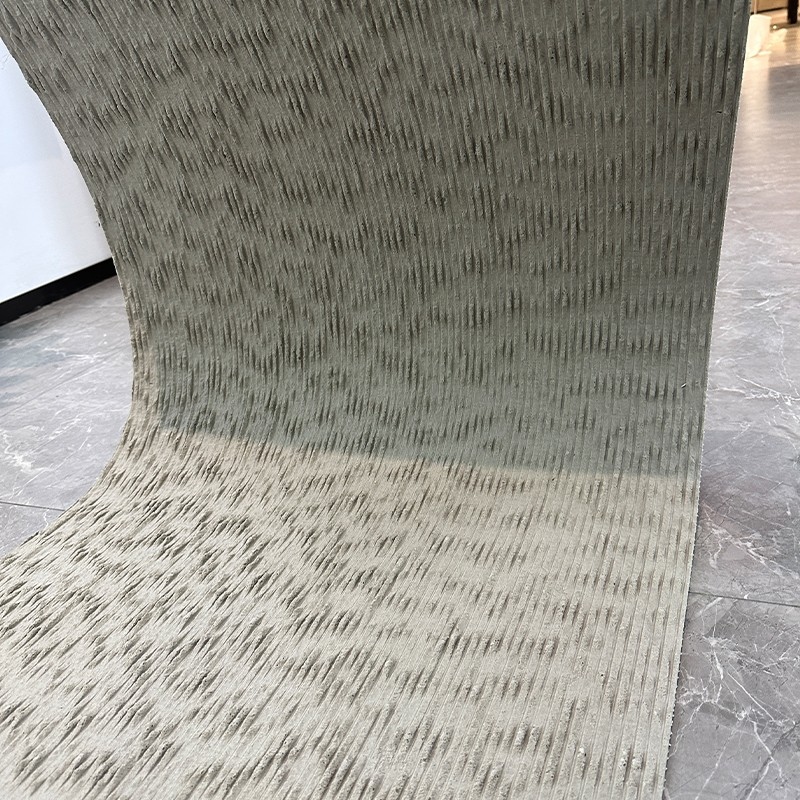
Until recently, a curved wall meant either a labor-intensive lath-and-plaster ordeal or a compromise with faceted panels that never quite flowed. Now, flexible substrates and computer-driven cutting have changed that. A single sheet can be kerfed on the back, bent around a radius that would have splintered older materials, and fixed in place without visible seams. The result is a continuous arc that reads as intentional, not as a fight against the material.
Tight corners pose a similar shift. Where two surfaces meet at an awkward angle, traditional trim and caulk often leave a clumsy joint. With precise digital templating and adhesives that tolerate slight movement, it is possible to wrap a wall skin into a corner and hold a crisp line. This opens up layouts that were previously avoided: alcoves with acute angles, curved niches, and transitions that feel more like sculpture than drywall.
Other details follow the same logic. Shadow gaps, concealed fasteners, and reveals that run along a curve no longer require a specialist with years of hand-tool experience. The limiting factor is less about whether a shape can be built and more about whether the design actually serves the space. Once you know the fabrication can handle it, the conversation shifts to proportion, light, and how people move through the room.
FAQ
A capable manufacturer does more than supply panels. They help with custom color matching, provide accurate technical data, and offer guidance on transitions and corners. This level of support can keep a project moving instead of stalling during installation.
MCM is engineered for durability. It resists scratches, moisture, and fading far better than many conventional wall finishes. When sourced from a manufacturer with strict quality control, the surface stays consistent across large runs, so a busy lobby or corridor still looks sharp years later.
Yes. Its flexible composition allows it to wrap gently around columns, arches, and curved feature walls without cracking or losing its texture. A manufacturer that understands forming techniques can advise on minimum radii and seam placement to keep the design clean.
The range is surprisingly broad. You can find finishes that mimic stone, wood, concrete, or metal, along with custom textures and colors. A responsive manufacturer will help you match existing furniture or branding, so the wall becomes a natural extension of the space.
Many MCM products are low-VOC and free of harmful additives, which matters for offices, schools, and healthcare spaces. It is worth asking the manufacturer for emissions documentation rather than assuming all products meet the same standard.
It is typically faster and cleaner. Panels can be cut with standard tools, and many systems use adhesive rather than heavy framing. A manufacturer that offers clear installation guides or on-site training reduces mistakes and shortens the overall schedule.
Strong production capacity means fewer delays when you need multiple batches with the same color. A manufacturer with experience across different building types can also spot potential issues early, from moisture barriers to fire ratings, so the design intent survives into the finished room.
Often, yes. Because it is lighter than many alternative materials, it can be applied over sound existing walls without major demolition. The key is having a manufacturer that offers proper surface preparation guidelines and compatible adhesives.
Conclusion
When walls stop being static backdrops and start participating in the room, the difference comes down to more than a fresh coat of paint. MCM interior wall coverings push past flat and boring through a combination of material science and manufacturing muscle. A serious manufacturer runs its own color matching lab, so you are not limited to a catalog of close enough options—shifts in tone, depth, and finish can be dialed in to fit the exact light and furniture palette of a space. At the same time, the panels are engineered to stay lightweight enough for fast, clean installation yet feel substantial to the touch. That hidden balance means you get the visual weight of a premium surface without the structural headaches that usually come with heavy cladding.
That same practical thinking shows up on renovation sites. MCM panels can wrap around curved walls and tuck into tight corners without the scoring, cracking, or delays that traditional materials often demand. Install days become predictable because the product arrives cut to spec, with samples and approvals handled early, so there is no back-and-forth between designer, contractor, and factory. From the first sample request to the final walkthrough, the process stays straightforward: you see exactly what you are getting, the panels arrive ready to fit, and the finished surface reads as intentional rather than compromised.
Contact Us
Contact Person: Vito
Email: [email protected]
Tel/WhatsApp: 86 13088879266
Website: https://www.magicstonemcm.com