

Glue Dispensing Machine Manufacturer Reveals Key Factors for Precision Bonding
2026-11-16
Flawless adhesive bonding is the difference between a product that lasts and one that fails prematurely. Yet many engineers overlook the critical dispensing parameters that determine bond strength and consistency. In this article, glue dispensing machine manufacturer JATEN reveals the key factors for achieving precision bonding in high-stakes applications. From viscosity control to valve response time, these insights will help you eliminate guesswork and improve yield.
What Most Manufacturers Overlook Before Dispensing Starts
Most attention goes to the dispenser itself, but the material's condition before it ever reaches the valve is where real problems hide. A cold two-part adhesive mixed too quickly traps air, leading to intermittent voids in the bead and uneven cure across the bond line. Likewise, a moisture-sensitive silicone opened a day earlier may have already started to skin over, changing its flow behavior enough to produce thin spots no machine adjustment can fix. Letting cartridges reach room temperature, degassing where the chemistry demands it, and tracking open-container time often matter more than tweaking air pressure.
Surface prep gets skipped or reduced to a quick wipe, yet residue from machining oils, mold release, or even fingerprint salts can defeat a properly calibrated dispense. A solvent that flashes off too fast leaves a chill mark that alters local surface energy, and the adhesive pulls back instead of wetting out. Simple checks with dyne pens or water-break tests on a few parts per shift will reveal defects that only show up after curing, when rework is far more expensive.
The last overlooked piece is validating the actual dispensing path before production starts. Needle tip height, retract settings, and line speed are often copied from an older program without accounting for a new lot of needles or a slightly different part contour. Running a dry cycle on a clear film or glass plate with the same material batch takes minutes and exposes skips, tails, or inconsistent dot diameters that will otherwise become scrap downstream. Log those setup values, not just the final parameters, and the next batch changeover won't repeat the same failures.
Viscosity Shifts: The Quiet Enemy of Repeatable Bonds
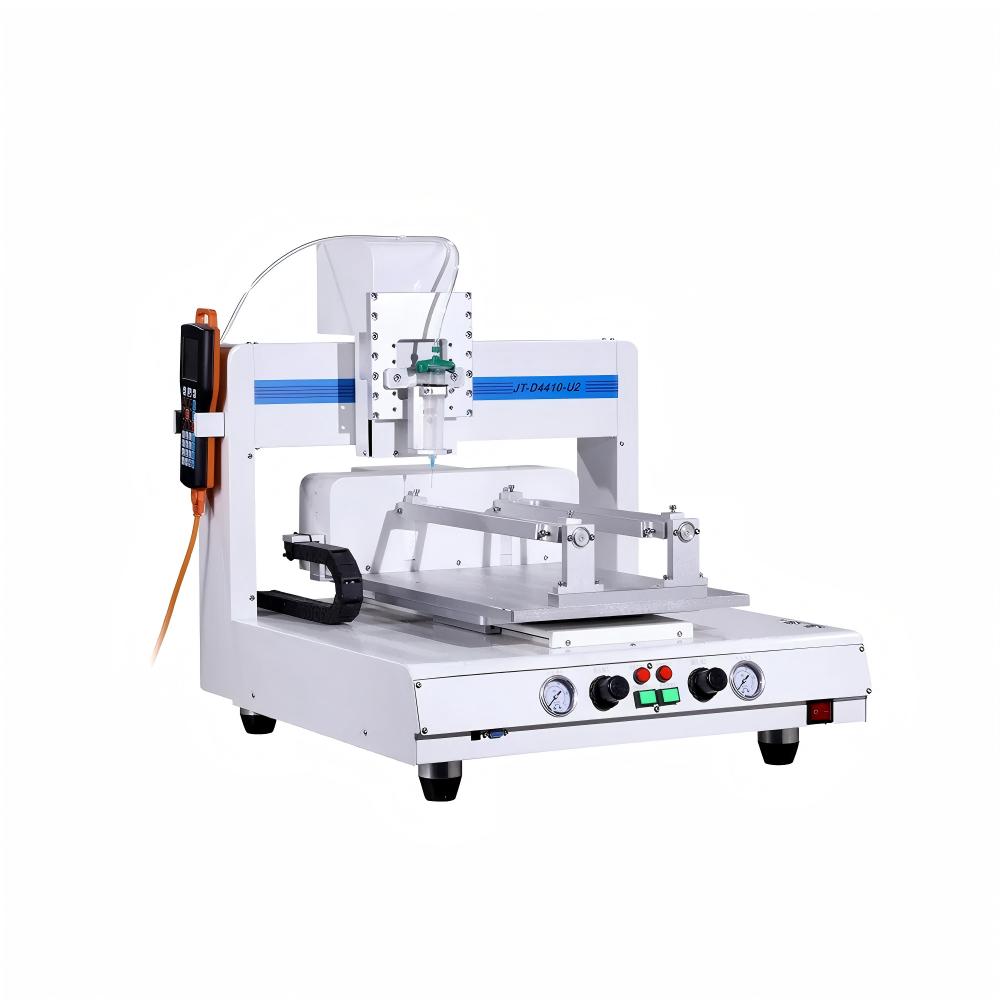
Viscosity rarely announces itself. It creeps into a batch, shifts the way adhesive flows, and suddenly a joint that held perfectly last week tears open under the same load. What changed wasn't the substrate or the curing schedule—it was the silent drift in how the material moved before it locked into place.
Repeatable bonds depend on a narrow window of flow. Too thin, and the adhesive starves the interface, leaving microvoids that become crack initiation sites. Too thick, and it can't wet the surface properly, creating pockets of unbonded area that look fine from the outside. Both failures look identical in a pull test: the bond line fails, and everyone blames the surface prep.
The quiet enemy wins when viscosity is checked once at the start of a shift and then ignored. Temperature swings, moisture uptake, and even the age of a mixed batch all nudge viscosity in ways that aren't visible until a bond fails. For repeatable results, you need to monitor flow as a process variable—not as a one-time qualification.
Nozzle Choices That Make or Break Edge Definition
The fluid nozzle and air cap pairing dictates whether you get a razor-sharp edge or a soft, blown-out transition. A smaller tip with moderate fan air can tighten the pattern, but push it too far and the center loads up while the edges turn grainy. Swapping nozzle sizes does more to change edge character than endlessly dropping air pressure.
Air cap horn design and cleanliness matter just as much as the nozzle bore. Clogged or unevenly spaced horns throw a ragged, fuzzy boundary that no amount of trigger control can fix. A properly matched cap with focused atomization air keeps the perimeter tight without starving the middle.
Viscosity matching is where most edge failures start. Thick paint through a tiny nozzle pulses and spits, leaving a broken edge that looks hand-trembled. Open up the nozzle or thin the material until you get a continuous, even taper. Chasing the smallest possible nozzle rarely rewards you with cleaner lines; it just punishes technique.
Why Acceleration Profiles Matter More Than Top Speed
Most riders fixate on the number at the top of a spec sheet, but that figure only tells you what happens after a long stretch of empty road. In real traffic, you rarely hold a vehicle at its limit for more than a heartbeat. What you feel constantly is the way power builds from a standstill, the smoothness of the mid-range surge, and how confidently you can overtake without downshifting twice. Acceleration profiles capture that texture, while top speed remains a distant, often unusable promise.
Two bikes with identical peak horsepower can feel completely different when the throttle opens. One might hesitate below 6,000 rpm and then lurch forward, while another delivers a linear, predictable push from the moment you twist your wrist. Those differences shape everyday confidence. A machine that responds cleanly at low revs makes city riding less tiring, and a strong mid-range allows you to slip through gaps without planning every move minutes in advance. Top speed never helps you merge onto a highway or pass a truck on a two-lane road.
Think of acceleration as the usable slice of performance. It is what gets you away from a green light briskly, keeps you safe when traffic speeds up unexpectedly, and makes a winding road feel alive rather than like a waiting game. Chasing a higher maximum velocity often means sacrificing gearing, weight, or low-end tractability. The real measure of a vehicle’s character is not how fast it can eventually go, but how willingly it builds speed in the moments you actually need it.
Thermal Drift and Its Subtle Effect on Bead Size
Thermal drift often starts as a small mismatch between the set temperature and the actual temperature at the melt zone. Over the course of a long print, the heating cartridge, thermistor, and surrounding metal block slowly change their thermal response. The result is that the polymer exiting the nozzle becomes slightly more or less viscous than expected. Since bead size depends on how much the material spreads before it cools, even a subtle shift in viscosity can make the extruded line slightly wider or narrower.
On many FDM machines, a rise of just two or three degrees Celsius in the hotend can lower the melt viscosity enough that the deposited bead flattens more under the nozzle pressure. The same flow rate then produces a wider, thinner track. In contrast, a drop in temperature tends to stiffen the melt, leaving a taller and narrower bead. Thermal drift also affects the cooling side of the process. If the print chamber gradually warms up, the bead stays soft longer and may spread outward, whereas a temperature drop can cause it to solidify before it has fully settled into its final shape.
Because the changes are usually under a tenth of a millimeter, many operators never notice them until they assemble parts with tight tolerances. The most practical way to reduce the effect is to monitor actual nozzle temperature during long runs and adjust the extrusion multiplier or temperature setpoint slightly as the session progresses. Some users also add thermal insulation around the hotend or use a silicone sock to stabilize the heat block. The key is to recognize that thermal drift is not a one-time calibration issue but a slow, ongoing shift that can quietly alter bead dimensions throughout a print.
The Maintenance Habit That Protects Micron-Level Accuracy
Most precision machining shops treat calibration like an annual chore, but the ones holding micron tolerances day after day do something quieter: they wipe down guideways before every shift, not after. Dust that settles overnight mixes with way oil into a lapping compound. By the time a formal service call catches the wear, the machine has already lost a few microns it will never get back. Reversing that sequence—cleaning first, then running the warm-up cycle—costs ten minutes and saves a rebuild.
Another habit that gets overlooked is logging thermal drift instead of chasing it. A five-axis mill will move a couple microns as spindle temperature stabilizes. Shops that hold tight work record the drift curve for each season and adjust offsets proactively. It sounds obsessive until you watch a batch of bearing bores drift out of spec at 2 p.m. because the afternoon sun hits the shop wall. A simple notebook entry from last July tells you to shift the datum by 0.003 mm before the same window of heat arrives.
The less visible upkeep matters too: checking air filtration for the linear scales, replacing desiccant in the cabinet, and never resting a part on the table with a bare hand. Skin oil is acidic enough to etch a reference surface over a long weekend. These are not the habits that make it into a maintenance manual's glossy section. They are the reason one shop holds 0.005 mm while the shop next door, with identical machines, cannot explain why its scrap rate creeps up every summer.
FAQ
Repeatability under real production conditions. A machine can hit a perfect dot size during a demo, but if the needle standoff drifts after an hour or the adhesive warms up and thins out, you lose the bond line. We focus on closed-loop pressure control and automatic height sensing so the first part and the thousandth part see the same deposition.
More than most people budget for. Viscosity shifts with temperature, humidity, and even the age of the material. If you don't compensate in real time, the same settings produce different bead widths. We recommend inline temperature conditioning and periodic rheology checks, especially with moisture-curing adhesives.
Because the robot is only one part of the system. Air pressure stability, needle condition, workpiece fixturing, and operator training all vary between sites. We've seen a worn needle tip cause more variation than a cheaper machine ever would. That's why we treat setup as a controlled variable, not an afterthought.
Not at all. A very fine needle can create high back pressure, shear the adhesive, or clog with fillers. Sometimes a slightly larger tapered tip with a shorter land gives you a cleaner, more consistent line than forcing material through the smallest opening. The needle geometry has to match the adhesive's filler size and flow behavior.
Yes, if you switch from time-pressure dispensing to servo-driven positive displacement. Time-pressure systems lag during rapid cycles, but a servo-driven valve moves a fixed volume regardless of viscosity swings. That lets you tighten tolerances while keeping cycle times flat, even on high-speed lines.
A perfectly placed bead still fails if the surface energy is too low. We recommend plasma or corona treatment for plastics, and a controlled cleaning step for metals. Even a fingerprint can change wetting enough to cause voids. Precision bonding starts before the adhesive leaves the needle.
You can't rely on visual inspection alone. We pair in-line vision for bead width and placement with periodic destructive pull tests. Data logging is the underrated piece here — if you trend pull strength against dispense parameters, you catch drift before it becomes a field failure.
Conclusion
A glue dispensing machine manufacturer lays out that precision bonding fails long before the first bead is laid. Many shops ignore substrate temperature, surface energy, and tip priming, then wonder why wetting is inconsistent. Viscosity shifts are the quiet enemy: a 2°C change or a batch variation can widen a bead or starve a joint, so real-time temperature compensation and periodic viscosity checks are non-negotiable. Nozzle choice is where edge definition is won or lost—tapered, stainless, or coated tips alter the tail-off and fillet shape, and a worn orifice can smear edges without warning.
Acceleration profiles matter more than top speed because a fast robot that jerks at corners will sling adhesive and create thin spots. Ramping speed smoothly through starts and stops keeps bead cross-section stable, especially on short paths. Thermal drift from motors, curing lamps, or ambient swings can shift bead size by microns over a shift, so warm-up cycles and thermal isolation of the metering valve help hold tolerance. Finally, the maintenance habit that protects micron-level accuracy is boring but decisive: clean wetted parts before adhesive skins, replace seals on a schedule, and log pressure and flow deviations. Shops that treat dispensing as a process, not a step, get repeatable bonds.
Contact Us
Contact Person: Volien
Email: [email protected]
Tel/WhatsApp: +86 18029161762
Website: https://www.jatentech.com/